
We all need to know our customers in order to create products they’ll actually buy. This is why the minimum viable audience idea is so powerful.
“Build an audience first. The product is the logical extension of the conversation.” – Brian Clark
It doesn’t start with the product. It starts with the customer.
That means the media you create—the daily podcast, weekly live streams, the monthly lead magnets—all contribute to attracting an audience. As that audience grows, you learn their needs, wants, hopes, fears, triggers, objections, and language.
That information allows you to build a worldview of your customer. And when you confirm that worldview in your media, it allows you to sell products they actually want to buy—often before you’ve even built them.
Think of the Theodore Roosevelt quote:
“Nobody cares how much you know until they know how much you care.”
What Is Empathy? (The Full Academic & Practical Breakdown)
Empathy consists of two parts:
- Cognitive empathy – The intellectual identification with the feelings, thoughts, or attitudes of another.
- Affective empathy – The vicarious experiencing of those feelings, thoughts, or attitudes.
Keep in mind, while they are close cousins, empathy is not sympathy.
Read More:
- Developing an Empathetic Marketing Strategy: A Framework for Authentic Connection: Developing an Empathetic Marketing Strategy: A Framework for Authentic Connection – markempai.com
- What Is Empathy in Marketing and Why It Matters: The Definitive Guide: What Is Empathy in Marketing and Why It Matters: The Definitive Guide – markempai.com
- Empathy in Marketing: The Definitive Guide to Connecting With Customers & Driving Unshakeable Brand Loyalty:Empathy in Marketing: The Definitive Guide to Connecting With Customers & Driving Unshakeable Brand Loyalty – markempai.com
- Empathetic Marketing: The Power of Empathy in Advertising That Builds Unbreakable Brand Loyalty: Empathetic Marketing: The Power of Empathy in Advertising That Builds Unbreakable Brand Loyalty – markempai.com
Empathy vs. Sympathy: The Research
| Aspect | Sympathy | Empathy |
|---|---|---|
| Perspective | Third-person (“I feel sorry for you”) | First-person simulation (“I feel with you”) |
| Emotional Involvement | Detached pity | Shared emotional state |
| Action Trigger | Comfort offering | Perspective-taking & solution design |
“…sympathy is a third-person emotional response, whereas empathy involves putting oneself in another person’s shoes.”
— Jesse Prinz, Professor of Philosophy, CUNY Graduate Center (Beyond Human Nature, 2012)“Empathy is the capacity to think and feel oneself into the inner life of another person.”
— Heinz Kohut, founder of self-psychology (How Does Analysis Cure?, 1984)“Empathy is a kind of emotional mimicry… it’s feeling what one takes another person to be feeling.”
— Jesse Prinz, summarizing Adam Smith
Historical Evolution of the Term
- 1909: German psychologist Theodor Lipps coins Einfühlung (“feeling into”) to describe aesthetic projection into art.
- 1911: Edward Titchener translates it into English as “empathy”.
- 18th Century: Adam Smith and David Hume describe “sympathy” as the mechanism of moral sentiment—essentially proto-empathy.
“No quality of human nature is more remarkable… than that of entering into the situations of others.”
— David Hume, A Treatise of Human Nature (1739)
Modern Neuroscience of Empathy
Neuroscientist Tania Singer (Max Planck Institute) and Jean Decety (University of Chicago) identified:
- Mirror neuron systems fire both when you act and when you observe someone else acting.
- Affective sharing (insula, anterior cingulate) = feeling their pain.
- Mentalizing (medial prefrontal cortex, temporoparietal junction) = understanding their thoughts.
“Empathy is not just one thing—it’s a suite of mechanisms.”
— Jean Decety, Social Neuroscience (2011)
Empathy in Marketing: The Data
| Study | Finding |
|---|---|
| World Advertising Research Center (2007) | Emotional ads outperform rational ones by 19% in sales impact. |
| IPA (Institute of Practitioners in Advertising, 2018) | Campaigns with >60% emotional content were 2x more profitable than rational ones. |
| Harvard Business Review (2015) | Customers with high emotional connection are 52% more valuable than highly satisfied ones. |
| Google’s Project Aristotle (2016) | Top-performing teams rank psychological safety (built via empathy) as #1 success factor. |
Empathy in Action: Real-World Examples
- P&G “Thank You, Mom” (2012 Olympics): $100M+ in sales uplift from emotional storytelling.
- Google “Reunion” (India/Pakistan, 2013): 14M views in 48 hours—no product mentioned until :58.
- Airbnb “Belong Anywhere” (2014): Shifted from functional (“cheap rooms”) to emotional (“belonging”). Stock soared post-launch.
“People don’t buy products. They buy better versions of themselves.”
— Aaron Orendorff, VP Marketing at Common Thread Collective
When Advertisers Empathize Effectively
You’ve seen it in ads that make you cry or click “Buy” without thinking.
Procter & Gamble’s ode to moms. Google’s dad recording his daughter.
Both use indirect selling: the product appears only after the heart is won.
“The best advertising doesn’t feel like advertising. It feels like a story you wish you were part of.”
— Ann Handley, Chief Content Officer, MarketingProfs
Introducing the Empathy Map: Origins & Evolution
Empathy maps emerged from user experience (UX) design but have been adapted across industries.
Key Researchers & Contributors
| Researcher | Contribution |
|---|---|
| David Gray (XPLANE, Gamestorming, 2010) | Created the canonical 4-quadrant empathy map. |
| Dr. James Patell (Stanford d.school) | Integrated into human-centered design: “Our users need a better way to _ BECAUSE _.” |
| Alex Osterwalder (Business Model Canvas) | Added “Pains” and “Gains” to align with value proposition design. |
| Jeanne Liedtka (Darden School of Business) | Applied empathy maps to corporate innovation—used by GE, IBM, 3M. |
| Indra Nooyi (former PepsiCo CEO) | Mandated empathy mapping for all new product launches (2010–2018). |
“Design thinking starts with empathy. Everything else is commentary.”
— Tim Brown, CEO, IDEO
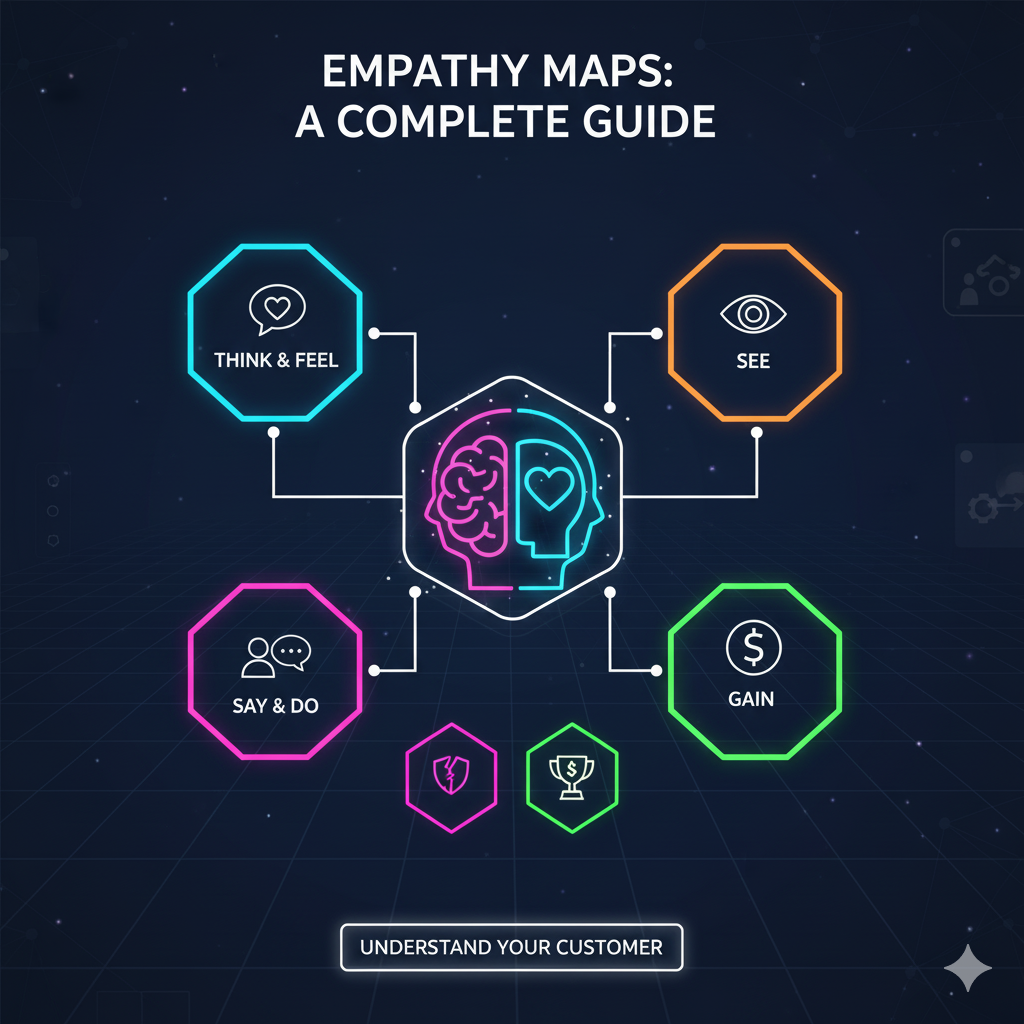
The Full Empathy Map Canvas (Expanded Version)
| Quadrant | Questions to Ask | Data Sources |
|---|---|---|
| THINKING | What occupies their mind? What do they believe? What matters to them? | Surveys, interviews, forum posts, search queries |
| FEELING | What emotions dominate? What worries them? What excites them? | NPS comments, support tickets, social sentiment |
| SEEING | What do they see in the market? Who influences them? What competitors do they admire? | Heatmaps, competitor reviews, influencer content |
| SAYING & DOING | What do they say publicly? What do they actually do? | Testimonials, behavior analytics, purchase history |
| PAINS | What frustrates them? What risks do they fear? What keeps them up at 3 a.m.? | Churn reasons, refund requests, negative reviews |
| GAINS | What do they want to achieve? What does success look like? What would make them brag? | Onboarding goals, success stories, vision boards |
Empathy Map Session: Step-by-Step (90-Minute Protocol)
Who to invite
- You
- Customer success lead
- Top affiliate
- Copywriter
- Product manager
- The intern who reads every review
What to bring
- Printed 3×4 ft empathy map
- 5 colors of sticky notes
- Customer interview transcripts
- Heatmaps & session recordings
- Social listening reports
- Your own unfiltered journal
90-Minute Flow
- 5 min – Silent individual fill (everyone writes 3 stickies per quadrant)
- 20 min – Group clustering & voting (dot vote top 3 per section)
- 15 min – Role-play: one person becomes the customer and speaks in first person
- 15 min – Pain/Gain sprint (fill bottom boxes)
- 15 min – Hypothesis generation (“We believe _ because _”)
- 10 min – Action items (who owns what by when)
- 10 min – Photo, share, schedule follow-up
Pro Tip: Record the session. Transcribe key quotes. Turn them into ad copy.
Advanced Empathy Mapping Techniques
| Technique | Use Case |
|---|---|
| Shadowing | Spend a day in your customer’s shoes (e.g., run their business using only your tool). |
| Diary Studies | Ask 10 customers to log thoughts for 7 days. |
| Jobs to Be Done (JTBD) | Reframe: “What job is the customer hiring your product to do?” (Clayton Christensen) |
| Emotion Curves | Plot emotional highs/lows across the customer journey. |
| Archetype Mapping | Combine with Jungian archetypes (Hero, Outlaw, Caregiver) for deeper storytelling. |
You Already Have the Raw Material
Every abandoned cart is data.
5-star review is a sticky note.
“I wish it did X” email is a quadrant entry.
“Your most unhappy customers are your greatest source of learning.”
— Bill Gates
Your Turn: Beyond the Map
Empathy maps are one tool. Others include:
- Customer advisory boards
- Live co-working sessions
- “Become your customer” challenges (many founders were broke solopreneurs first)
- AI-powered sentiment analysis (e.g., MonkeyLearn, Brandwatch)
- Ethnographic immersion (live in their world for 30 days)
We solve the problems we once had.
That’s why every feature started as a late-night frustration.
FAQ: Empathetic Marketing
Further Reading & Research:
- Empathy-Based Marketing: Empathy-Based Marketing – markempai.com
- Why Empathy in Marketing Is More Important Than Everything Else: Why Empathy in Marketing Is More Important Than Everything Else – markempai.com
- Why Empathy in Marketing Is Important: Why Empathy in Marketing Is Important – markempai.com
- Why Empathy in Marketing Matters More Than Ever: An Evidence-Based Guide: Why Empathy in Marketing Matters More Than Ever: An Evidence-Based Guide – markempai.com
- The Importance of Empathy in Marketing: The Importance of Empathy in Marketing: A Three-Part Series – markempai.com
- Developing an Empathetic Marketing Strategy: A Framework for Authentic Connection: Developing an Empathetic Marketing Strategy: A Framework for Authentic Connection – markempai.com
- What Is Empathy in Marketing and Why It Matters: The Definitive Guide: What Is Empathy in Marketing and Why It Matters: The Definitive Guide – markempai.com
- Empathy in Marketing: The Definitive Guide to Connecting With Customers & Driving Unshakeable Brand Loyalty:Empathy in Marketing: The Definitive Guide to Connecting With Customers & Driving Unshakeable Brand Loyalty – markempai.com
- Empathetic Marketing: The Power of Empathy in Advertising That Builds Unbreakable Brand Loyalty: Empathetic Marketing: The Power of Empathy in Advertising That Builds Unbreakable Brand Loyalty – markempai.com
- The Role of Empathy in Modern Marketing: How Emotional Intelligence Drives Sustainable Business Success: The Role of Empathy in Modern Marketing: How Emotional Intelligence Drives Sustainable Business Success – markempai.com
- Empathetic Marketing: The Ultimate Guide to Building Authentic Customer Connections in 2025: Empathetic Marketing: The Ultimate Guide to Building Authentic Customer Connections in 2025 – markempai.com
Because the only way to win is to crawl inside their head—and hand them the solution they’ve been praying for.
Ready to Transform Your Marketing Through Empathy?
If you’re ready to harness the proven power of empathetic marketing, the team at Markempai is here to help. With our unique blend of psychological insight, strategic rigor, and creative excellence, we deliver measurable results that strengthen both your brand and your bottom line.
markempai.com |info@markempai.com