
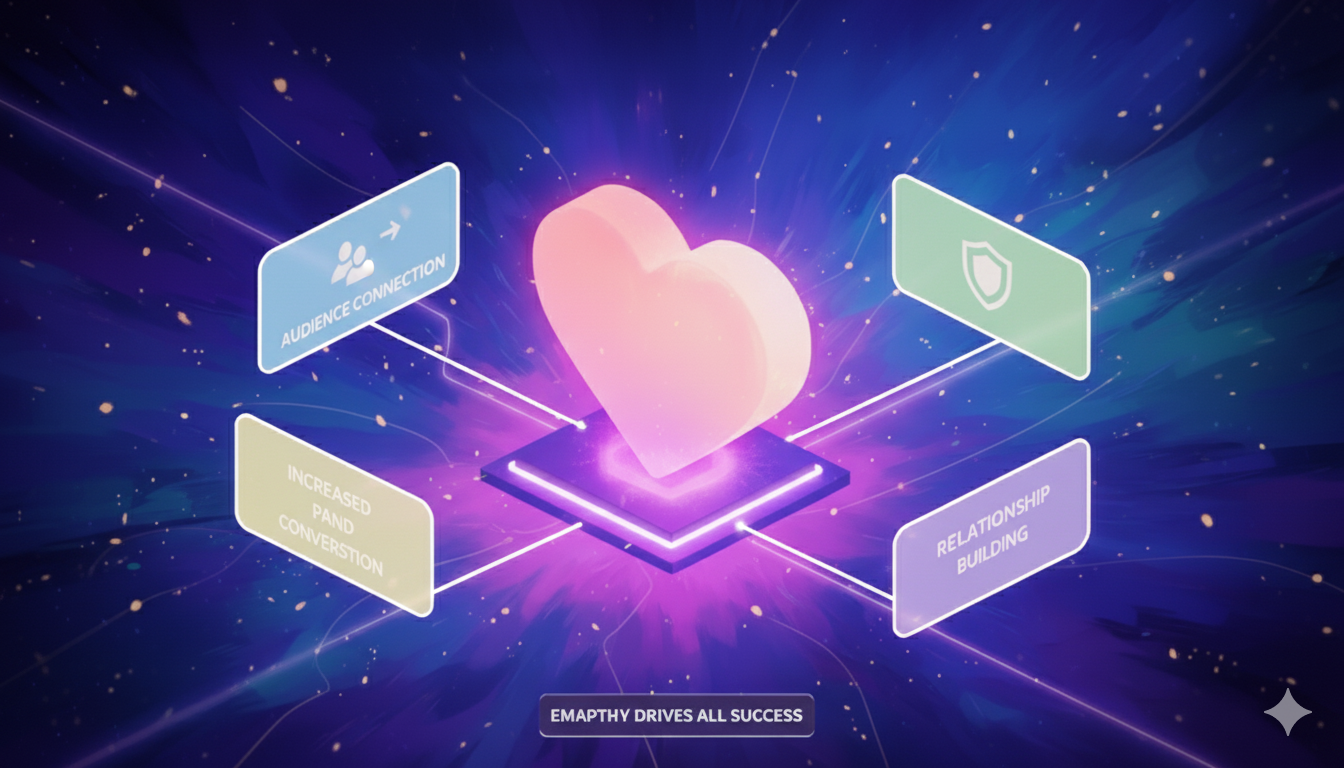
Empathy is the highest form of emotional intelligence, a non-negotiable for leaders. For marketers, it’s not a “soft skill”; it’s our most powerful hard asset.
In the golden age of martech and big data, we’ve become obsessed with numbers. We track clicks, conversions, and engagement rates with religious fervor. This data is, without a doubt, an invaluable asset for targeting and personalization. But in our quest to quantify everything, we’ve committed a critical error: we’ve forgotten the human beings behind the data points.
Data informs, but it doesn’t connect. Understanding your customer—truly grasping their fears, aspirations, and daily struggles—is what forges authentic relationships. That’s why at Markempai, we believe that infusing empathy into marketing isn’t just a strategy; it’s the foundational pillar for a truly customer-centric approach that delivers sustainable growth.
Empathy is the highest form of emotional intelligence, a non-negotiable skill for modern leaders. For marketers, it’s not a “soft skill”; it’s our most powerful hard asset.
READ MORE:
Empathy-Based Marketing: Empathy-Based Marketing – markempai.com
Empathy Maps: A Complete Guide: Empathy Maps: A Complete Guide – markempai.com
Why Empathy in Marketing Is Important: Why Empathy in Marketing Is Important – markempai.com
This sentiment is powerfully articulated by Noah Fenn in his seminal piece: “Despite All This Data, Empathy is Still the Greatest Tool in a Marketer’s Toolbox.” This resonates deeply with our core philosophy at Markempai.
While we have more channels than ever to reach customers, building genuine trust has never been more difficult. When your brand fails to demonstrate empathy, you’re not just missing a connection—you’re actively ceding business to competitors who understand this fundamental truth. Empathetic marketing is the only way forward.
Quick Takeaways:
- Empathy is the core of emotional intelligence and modern leadership.
- “Collective amnesia” causes marketers to forget they are marketing to humans like themselves.
- Data and empathy are not opposites; they are complementary forces.
- Human connection cannot be replicated by algorithms.
- Empathy-driven strategies are proven to increase customer loyalty, lifetime value, and brand advocacy.
What is Empathetic Marketing? Moving Beyond a Buzzword
Empathetic marketing is the strategic practice of perceiving the world through your customer’s lens. It requires a deep, qualitative understanding of who they are, the challenges that keep them up at night, and the underlying motivations that drive their decisions—what renowned Harvard Business School professor Theodore Levitt famously pointed out when he said, “People don’t want to buy a quarter-inch drill. They want a quarter-inch hole.”
We must learn to think like our customers and walk the journey they take—a path often cluttered with anxiety, information overload, and the desire for a trusted guide. To incorporate empathy into your marketing strategy, these principles are essential. For a deeper dive, explore our guide on how to build a customer-centric marketing strategy.
- Practice Customer-Obsessed Focus: Place the customer at the center of every decision. Help them find a solution by first seeking to understand their desired outcome.
- Foster Dialogue, Not Monologue: Shift from pushing your brand to having conversations. This means listening actively and speaking with the intent to help, not just to close.
- Deliver Anticipatory Content: Don’t guess what your leads want. Know them so intimately that your content feels like it was created specifically for them. If it isn’t helpful, it’s harmful noise.
- Listen for Emotional Cues: True buyer intent is often unspoken. Empathetic listening involves detecting the emotions—fear, trust, ambition, frustration—behind the words, allowing you to craft messages that resonate on a profound level.
Why Successful Marketing Is More Than Just Advertising
We are witnessing a paradigm shift. Companies are increasingly slashing traditional ad budgets in response to a fundamental truth: consumers are desensitized and distrustful of interruptive advertising.
This is compounded by the fact that consumers are now empowered researchers. Studies from Gartner show that nearly 80% of the buyer’s journey is completed before a prospect ever engages with a salesperson. Customers are self-educating; they don’t need to be told how great you are. They need helpful, unbiased information to make their own informed decisions.
A telling example is Coca-Cola’s decision to eliminate the CMO role in favor of a “Chief Growth Officer.” This wasn’t an abandonment of marketing, but a radical reorientation from product-centric advertising to a holistic strategy focused on business growth by satisfying evolving customer needs.
This brings to life one of our favorite quotes, from HP co-founder David Packard:
“Marketing is too important to be left to the Marketing department.”
The Indisputable Need for Empathy in Marketing
Fenn’s experience at AOL highlights an industry-wide ailment: over-complication. We build complex systems and campaigns based on data, hoping they will resonate, but often they fall flat because they lack human understanding.
The danger is that data dependence creates innovation-blind spots. Dr. Johannes Huttula’s research with 480 marketing managers revealed a shocking paradox: the more empathetic the marketers felt, the worse they performed at predicting customer preferences. Why? They were projecting their own biases onto customers, a trap we call “assumptive empathy.”
The solution is a symbiotic relationship: use data as the compass to identify opportunities, and empathy as the map to navigate them meaningfully.
And for those who think empathy is an innate trait you either have or you don’t, think again. As Dr. Helen Riess outlines in her groundbreaking book, “The Empathy Effect,” empathy is a trainable, neurological skill. We can all learn to strengthen our empathetic muscles.
Empathy as the Cornerstone of Modern Brand Building
Let’s return to Coca-Cola. The previous CMO advocated for a product-centric approach: “Show people loving to drink Coca-Cola.” But does that truly build a brand in the 21st century?
Today’s consumers, particularly younger generations, gravitate towards brands that share their values. Coca-Cola’s work to highlight its commitments to sustainability and its “Honest” product line is a direct attempt to bridge the empathy gap by aligning with customer values on health and environmental responsibility.
How to Become an Empathetic Marketer: A Practical Framework
Empathy-based marketing is built on a foundation of trust. The Edelman Trust Barometer provides compelling data on why this matters:
- Trust is a Decision Driver: It is nearly as valuable as quality and value in the purchasing process.
- Distrust is the Default: 53% of consumers believe they can spot corporate dishonesty.
- Values Drive Value: A majority of buyers expect brands to engage on social issues.
To build this trust, you must systematically embed empathy into your operations.
1. Apply Empathy to Customer Problems
Neuroscientist Antonio Damasio’s revolutionary work proved that “We are not thinking machines that feel, we are feeling machines that think.” Emotion is the bedrock of decision-making. This is critical in B2B and complex sales, where risk is high. Your customers aren’t saying, “We need a solution.” They’re saying, “We need to solve this problem that is causing us pain.” Frame your entire message around this reality.
2. Architect Your Website for Empathy
Your website is your digital front door. Is it welcoming or bewildering? As one executive told us, “We design our content so a high-school freshman could understand it.” Complexity is arrogance; clarity is empathy. Long forms, confusing navigation, and jargon are all forms of disrespect for your customer’s time and intelligence. Learn more about creating a high-converting, empathetic website UX.
3. Cultivate Empathy from the Inside Out
You cannot deliver a transcendent customer experience with a disengaged workforce. This is a core tenet of our employee advocacy program development services. Employees who feel valued, recognized, and empowered become your most authentic and empathetic brand ambassadors.
4. Adopt a “Help First” Content Strategy
Abandon the “always be closing” mentality for a “always be helping” philosophy. Your content marketing should aim to solve problems without immediately asking for something in return. This builds authority and trust, which ultimately drives revenue. This is the heart of our content marketing service approach.
5. Listen, Learn, and Evolve
Active listening is the most potent tool in the empathetic marketer’s kit. Use social listening, surveys, and direct customer feedback not as a data collection exercise, but as a strategic input to evolve your products, services, and messaging.
Fixing the Brand-Customer Empathy Gap: Your Action Plan
Here is a concrete plan to bridge the gap:
- Prioritize Connection over Conversion: Build a relationship first; the transaction will follow.
- Conduct a Bias Audit: Before any campaign, ask: “Is this based on validated customer insight or my own internal assumption?”
- Map Core Emotional Motivators: Use the work of psychologists like Steven Reiss to understand the 16 basic desires that drive all human behavior. Design messages that speak to these.
- Implement Agile Empathy Testing: Use A/B testing not just for headlines, but for emotional messaging.
- Scale Customer Insights: Systematically transfer successful empathetic insights across all channels.
Empathy in Advertising: The Antidote to Ad Blockers
Imagine being forced to watch a movie with interruptions every 15 minutes. This is the reality of much online advertising. It’s no wonder ad-blocker usage is at an all-time high.
Noah Fenn correctly identifies this as a symptom of “collective amnesia.” Marketers forget they are consumers themselves who despise poor ad experiences. The cure is empathy.
The easiest thing to empathize with is time. A 30-second pre-roll before a one-minute video is not a fair value exchange. We must break free from the “30-second mania” of the TV era and create native, valuable, and respectful ad experiences that people might actually choose to engage with.
Conclusion: The Empathetic Future
The brands that will thrive in the coming decade are not those with the biggest budgets, but those with the deepest connections. They understand that marketing is a service, not a shout.
As Dr. Damasio’s research confirms, we are feeling machines that think. Logic justifies, but emotion decides.
Your customers are feeling machines. It’s time we started marketing to their hearts.
Further Reading & Research:
- Empathy-Based Marketing: Empathy-Based Marketing – markempai.com
- Empathy Maps: A Complete Guide: Empathy Maps: A Complete Guide – markempai.com
- Why Empathy in Marketing Is Important: Why Empathy in Marketing Is Important – markempai.com
- Why Empathy in Marketing Matters More Than Ever: An Evidence-Based Guide: Why Empathy in Marketing Matters More Than Ever: An Evidence-Based Guide – markempai.com
- The Importance of Empathy in Marketing: The Importance of Empathy in Marketing: A Three-Part Series – markempai.com
- Developing an Empathetic Marketing Strategy: A Framework for Authentic Connection: Developing an Empathetic Marketing Strategy: A Framework for Authentic Connection – markempai.com
- What Is Empathy in Marketing and Why It Matters: The Definitive Guide: What Is Empathy in Marketing and Why It Matters: The Definitive Guide – markempai.com
- Empathy in Marketing: The Definitive Guide to Connecting With Customers & Driving Unshakeable Brand Loyalty:Empathy in Marketing: The Definitive Guide to Connecting With Customers & Driving Unshakeable Brand Loyalty – markempai.com
- Empathetic Marketing: The Power of Empathy in Advertising That Builds Unbreakable Brand Loyalty: Empathetic Marketing: The Power of Empathy in Advertising That Builds Unbreakable Brand Loyalty – markempai.com
- The Role of Empathy in Modern Marketing: How Emotional Intelligence Drives Sustainable Business Success: The Role of Empathy in Modern Marketing: How Emotional Intelligence Drives Sustainable Business Success – markempai.com
- Empathetic Marketing: The Ultimate Guide to Building Authentic Customer Connections in 2025: Empathetic Marketing: The Ultimate Guide to Building Authentic Customer Connections in 2025 – markempai.com
Ready to Transform Your Marketing Through Empathy?
If you’re ready to harness the proven power of empathetic marketing, the team at Markempai is here to help. With our unique blend of psychological insight, strategic rigor, and creative excellence, we deliver measurable results that strengthen both your brand and your bottom line.
markempai.com |info@markempai.com