
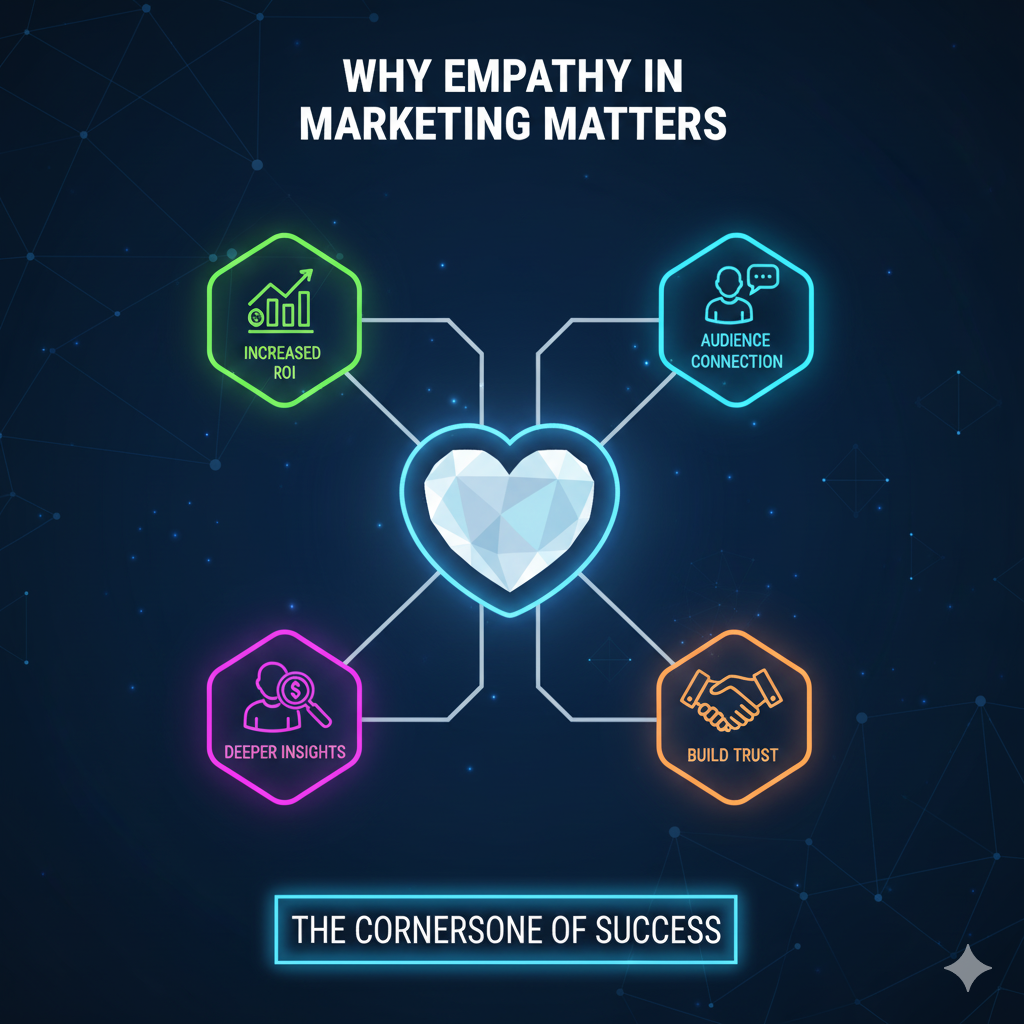
Empathy in marketing isn’t just a nice thing to have—it’s the essential for building a lasting brand, fostering company growth, and advancing your career.
This isn’t merely a philosophical stance; it’s a strategic imperative. By consciously and consistently putting yourself in the shoes of your company’s customers, clients, and employees, you can cut through the noise to create more relatable, engaging, and effective campaigns that resonate on a profoundly human level. This empathetic approach is what separates transactional brands from transformational ones.
To capture the pulse of this movement, we spoke to 18 marketing leaders from the esteemed Marketers That Matter community about the critical importance—and tangible effectiveness—of empathy in modern marketing. Their collective insights, combined with groundbreaking research, reveal why this connectedness matters more today than ever before and what marketing leaders can do to cultivate and demonstrate a genuine ability to empathize with consumers and key stakeholders.
What is Empathy?
Elevated empathy is now a non-negotiable for anyone aspiring to a leadership role. The dictionary provides a foundational definition: the action of understanding, being aware of, being sensitive to, and vicariously experiencing the feelings, thoughts, and experiences of another.
Author, thought leader, and empathy expert Brené Brown provides a more potent, operational definition, succinctly describing it as “a way to connect to the emotion another person is experiencing.” In short, it’s feeling with others, a process that leaves people feeling seen, heard, and more connected.
Further expanding on this, Dr. Helen Riess, a psychiatrist and author of “The Empathy Effect,” outlines the neurobiology of empathy in her research. She identifies key components, including:
- Affective Empathy: Sharing another person’s emotions.
- Cognitive Empathy: Understanding another person’s perspective.
- Empathic Concern: The motivation to care for someone’s well-being.
For marketers, this triad is crucial. It means we must not only understand our customer’s problems (cognitive) and feel their frustrations (affective) but also be driven to genuinely help them (concern). This is the bedrock of our philosophy in developing a customer-centric marketing strategy that delivers real results.
The Data-Driven Case for Empathy: Why Now?
The push for empathy is more than a reaction to AI; it’s a response to a profound market shift. The 2024 Edelman Trust Barometer reveals that 68% of consumers believe brands are more effective than governments at driving positive social change. This places an unprecedented responsibility on companies to understand and act upon the needs and values of their stakeholders.
Empathy in Marketing Humanizes Brands in the Age of AI
The leaders we spoke to universally highlighted empathy as the key differentiator in a technologically saturated world.
“Human skills are more critical than ever, such as, understanding human issues and emotions, knowing how to communicate and collaborate, when to say no, and why you are saying it. We are crossing over from the information age to the relationship age. We need as much imagination as we do hard, technical skills.”
– Geoffrey Colon, Former Senior Director of Digital Marketing, Dell Technologies
“The leadership muscle of the future has to be empathy, with a close second being accountability. Marketers must be willing to speak with their customers and become students of psychology, sociology, and cultural anthropology.”
– Matt Kerbel, Director, Strategic Brand Planning, Turo
“At LinkedIn, we have a great conviction to lean into the things that AI cannot replace. We often talk about IQ versus EQ, wherein a certain level of humanity is needed along with the use of AI to achieve our ambitions.”
– Santi Pochat, VP, Brand, LinkedIn
“The most important leadership skills of the future are emotional intelligence, self-awareness, empathy, and the willingness to see and consider problems through our internal partners’ and customers’ eyes.”
– Abigail Jacobs, SVP Of Integrated Marketing and Brand, Sephora
This collective insight underscores a vital point: as automation handles more tactical tasks, the human capacity for connection, understanding, and emotional intelligence becomes the ultimate competitive advantage. This is why we emphasize integrating emotional intelligence into your marketing leadership style.
Empathy Builds Inclusive and Powerful Communities
“First of all, it’s so easy to think about ‘target audience, target market, customers, prospects, users, users, users’ and forget that they’re also ‘us.’ Secondly, there is a whole group of people who rarely, if ever, see themselves reflected in ads, and let me assure you, speaking as a queer, masculine-of-center woman, I can guarantee you we both notice and become devoted fans at a much faster pace when you include us.”
– E Gilliam, Director of Brand and Creative, Equinix
“Moving to the U.S. from Germany in middle school taught me a lot about empathy and putting myself in others’ shoes. From a customer’s perspective, I always consider how different people might take something in and how we need to consider diverse groups of people.”
– Sheila Pollak, Chief Brand Experience Officer, Orvis
The business case for this inclusive empathy is robust. According to a 2023 study by Accenture, companies that are perceived as inclusive and diverse in their marketing see a potential lift in purchase intent of up to 39% among underrepresented groups and their allies. Empathy isn’t just morally right; it’s commercially astute.
Empathy Creates Authentic Meaning and Value for Customers
When empathy guides strategy, marketing shifts from selling to serving. It becomes the engine for creating genuine value.
“The leaders I most admire display an overabundance of emotional intelligence. They can take the perspectives of their business partners in negotiations to reach a compromise that all parties are happy with, and they can put themselves in their customers’ shoes, synthesizing with specificity why their product creates meaning and value.”
– Stacey Jaffe, Senior Vice President of Data & Digital Strategy, Scholastic
“The essential leadership muscle we must always exercise is the ability to listen to the consumer. It’s become easier than ever to get lost in a lot of data, but nothing replaces a deep and true understanding of consumer behavior: What are their tensions? What are they looking for? How can we best respond to that in real-time?”
– Paloma Azulay, VP Of Brand Marketing, Hulu, The Walt Disney Company
“Everyone can learn technical skills, but the real magic comes from the art of being empathetic to the customer. If the customer wins, we win. Try to put yourself in the customer’s shoes and build strategic go-to-market plans around that; this skill set is valuable.”
– Jenny Hooks, Leader of Americas Field Marketing, Cisco
“Find people who are curious, care about the audience, and think customer-first. Then, once you’ve found marketers who sincerely care, figure out how to adapt the tools. We’re brand marketers. Our job is to hire smart agencies to partner with the greatest technologists and to find those folks who can bring our story to life. But always pick the people who hold the brand story closest to them.”
– David Bornoff, Former Head of Brand Marketing, DoorDash
This aligns with the concept of “Jobs to Be Done,” pioneered by the late Harvard Business School professor Clayton Christensen. He argued that customers don’t buy products; they “hire” them to get a job done in their lives. Empathy is the tool that allows us to discover that job and its accompanying emotional and social dimensions. This is the core of our approach to empathy-driven content marketing that builds lasting loyalty.
Empathy Makes You a More Effective and Influential Team Player
The power of empathy isn’t confined to external marketing; it’s the glue that holds high-performing teams and cross-functional partnerships together.
“Being a leader means listening well and empathizing with those you work with. Caring not only about the work you do but the people you work with makes such a difference.”
– Adaora Ugokwe, Sr. Director, Marketing & Brand Strategy, BET
“We have so many cross-functional partners, and each of those partners have their own goals. If we push our goals too aggressively, they won’t want to partner with us. So, we listen, have deep empathy, and identify where our goals overlap. We also try to do what is right for our customers and business, even if it’s not what’s best for product marketing, which also helps to build trust.”
– Greg Powell, Senior Director of Small Business Marketing, Indeed
“Great marketers have empathy, use data, and are storytellers. We must focus as much attention on internal audiences as external ones and spread the message of bringing your whole self to work.”
– Brad Jakeman, Chairman of the Board, The Humane Society, Senior Advisor, BCG
Research from the Google Aristotle Project, which studied hundreds of teams, found that the highest-performing teams were characterized by “psychological safety”—a shared belief that the team is safe for interpersonal risk-taking. This environment is cultivated primarily through empathetic leadership and communication.
Empathy Helps You Lead with Your Team’s Whole Self in Mind
Modern leaders are expected to navigate not just business challenges, but the complex human realities of their teams.
“I started my job four weeks before the murder of George Floyd and since then, the COVID pandemic, the Ukraine war, and now the Israel and Palestine war. As a leader, I have to be well-rounded, authentic, and empathetic towards my colleagues. I have to be aware of my colleagues’ mental health and provide them with the necessary breaks. The expectations are far different from what they were even 10 years ago.”
– Lizette Williams, Global Head Of Vertical Solutions Marketing, Meta
“I believe we should show up as humans and not just leaders or managers. I share authentically with my team how I struggle at times and some areas of my personal development.”
– Gemini Babla, Director of Marketing and Partnerships, Google
“We need to meet people where they are. Let them grieve, dig through the worst-case scenarios to confront their fears, and then help get them on an upward trajectory.”
– Elle McCarthy, fractional brand executive, PayPal
This level of empathetic leadership is directly tied to retention. A 2024 report from Gallup found that employees who feel their manager cares about them as a person are significantly more likely to be engaged and less likely to experience burnout. This internal application of empathy is critical for building trust within your team and with your customers.
Empathy Systematically Grows Your Influence and Impact
Ultimately, empathy is a powerful tool for influence, both internally and in the marketplace.
“Emotional intelligence is undervalued, but it’s becoming more prominent. In business, it’s all about influence. The best influence is mutual, where you can understand the drivers, constraints, and stressors of others and filter what you’re trying to do through their lens.”
– Nii Mantse Addy, CMO, Philo
“Everyone knows how to be kind. It’s as simple as choosing in the morning that you’re going to show up that way. I promise you’ll be happier if you do it in all aspects of your life.”
– Greg Lyons, CMO of PepsiCo Beverages North America (PBNA)
This echoes the principles in Robert Cialdini’s classic, Influence: The Psychology of Persuasion. One of his key principles is “Liking”—people are more easily influenced by those they know and like. Empathy, which fosters genuine connection and understanding, is the fastest path to building that rapport and trust.
More Actions Leaders Can Take to Systematically Boost Empathy in Marketing
Establishing a sustainable culture of empathy within your marketing team requires intentional, repeatable actions—and a firm commitment to understanding and supporting each team member. Here are some practical, evidence-based steps leaders can take to enhance empathy at work:
- Model the Behavior You Want to See: Show vulnerability, admit when you don’t have all the answers, embrace change, and demonstrate the resilience you want to see in your team. This sets the tone from the top and gives others permission to be human.
- Be Vocal and Honest with Your Leadership Team: Outline the challenges and bring attention to their blind spots to help them make more informed (and empathic) decisions. Use data and customer stories to build your case for empathetic initiatives.
- Be Real and Be Human in Times of Change: When sharing company updates, you might not be able to guarantee stability, but you can guarantee support. Most of the time, how leaders deliver news impacts how the team feels more than the news itself. This builds psychological safety.
- Maintain Mentoring Relationships with Skip-Levels: Consider quarterly check-ins with junior team members. Ask for honest feedback and show that it’s safe for employees to provide it so you can better understand the inner workings of the overall team and stay self-aware of how you are perceived.
- Get Creative with Empathetic Prompts: Replace basic questions like “How are you doing?” and “What’s on your mind?” with questions that spark more thoughtful answers. Instead, try asking, “What one word describes how you’re feeling this week?” or “What’s one thing I can do to alleviate stress for you this week?” Ensuring you have EQ-based questions built into 1:1 meetings and reviews will go a long way in building a sense of psychological safety.
- Utilize Established Psychological Frameworks: Use tools like the Kübler-Ross Change Curve, a model extensively used by individuals and organizations to help people “understand their reactions to significant change or loss,” as a support tool to help your team members better identify with how they’re feeling and normalize the emotional process of adaptation.
- Conduct Regular “Empathy Mapping” Sessions: Gather your team to collaboratively map out what your key customer segments are seeing, hearing, thinking, feeling, and doing. This structured exercise, often used in design thinking, makes empathy a tangible, team-based activity. For a deeper dive into leveraging technology for this, explore our insights on the intersection of AI and empathy in modern marketing.
Conclusion: The Empathetic Imperative
As illustrated by the collective wisdom of leaders from the Marketing That Matters community and supported by a growing body of research, empathy is the force that fosters true loyalty and trust. By systematically prioritizing emotional intelligence, actively understanding diverse perspectives, and maintaining radically open communication, marketing leaders can create environments where both teams and customers feel genuinely valued and heard.
This commitment is what separates good leaders from great ones and elevates marketing from a cost center to a growth engine. Embracing empathy in marketing does not just help humanize brands in an automated world; it’s demonstrably good for the bottom line, the health and retention of marketing departments, and the greater well-being of the world we all share.
FAQ: Empathetic Marketing
Further Reading & Research:
- Empathy-Based Marketing: Empathy-Based Marketing – markempai.com
- Empathy Maps: A Complete Guide: Empathy Maps: A Complete Guide – markempai.com
- Why Empathy in Marketing Is More Important Than Everything Else: Why Empathy in Marketing Is More Important Than Everything Else – markempai.com
- Why Empathy in Marketing Is Important: Why Empathy in Marketing Is Important – markempai.com
- The Importance of Empathy in Marketing: The Importance of Empathy in Marketing: A Three-Part Series – markempai.com
- Developing an Empathetic Marketing Strategy: A Framework for Authentic Connection: Developing an Empathetic Marketing Strategy: A Framework for Authentic Connection – markempai.com
- What Is Empathy in Marketing and Why It Matters: The Definitive Guide: What Is Empathy in Marketing and Why It Matters: The Definitive Guide – markempai.com
- Empathy in Marketing: The Definitive Guide to Connecting With Customers & Driving Unshakeable Brand Loyalty:Empathy in Marketing: The Definitive Guide to Connecting With Customers & Driving Unshakeable Brand Loyalty – markempai.com
- Empathetic Marketing: The Power of Empathy in Advertising That Builds Unbreakable Brand Loyalty: Empathetic Marketing: The Power of Empathy in Advertising That Builds Unbreakable Brand Loyalty – markempai.com
- The Role of Empathy in Modern Marketing: How Emotional Intelligence Drives Sustainable Business Success: The Role of Empathy in Modern Marketing: How Emotional Intelligence Drives Sustainable Business Success – markempai.com
- Empathetic Marketing: The Ultimate Guide to Building Authentic Customer Connections in 2025: Empathetic Marketing: The Ultimate Guide to Building Authentic Customer Connections in 2025 – markempai.com
Ready to Transform Your Marketing Through Empathy?
If you’re ready to harness the proven power of empathetic marketing, the team at Markempai is here to help. With our unique blend of psychological insight, strategic rigor, and creative excellence, we deliver measurable results that strengthen both your brand and your bottom line.
markempai.com |info@markempai.com