
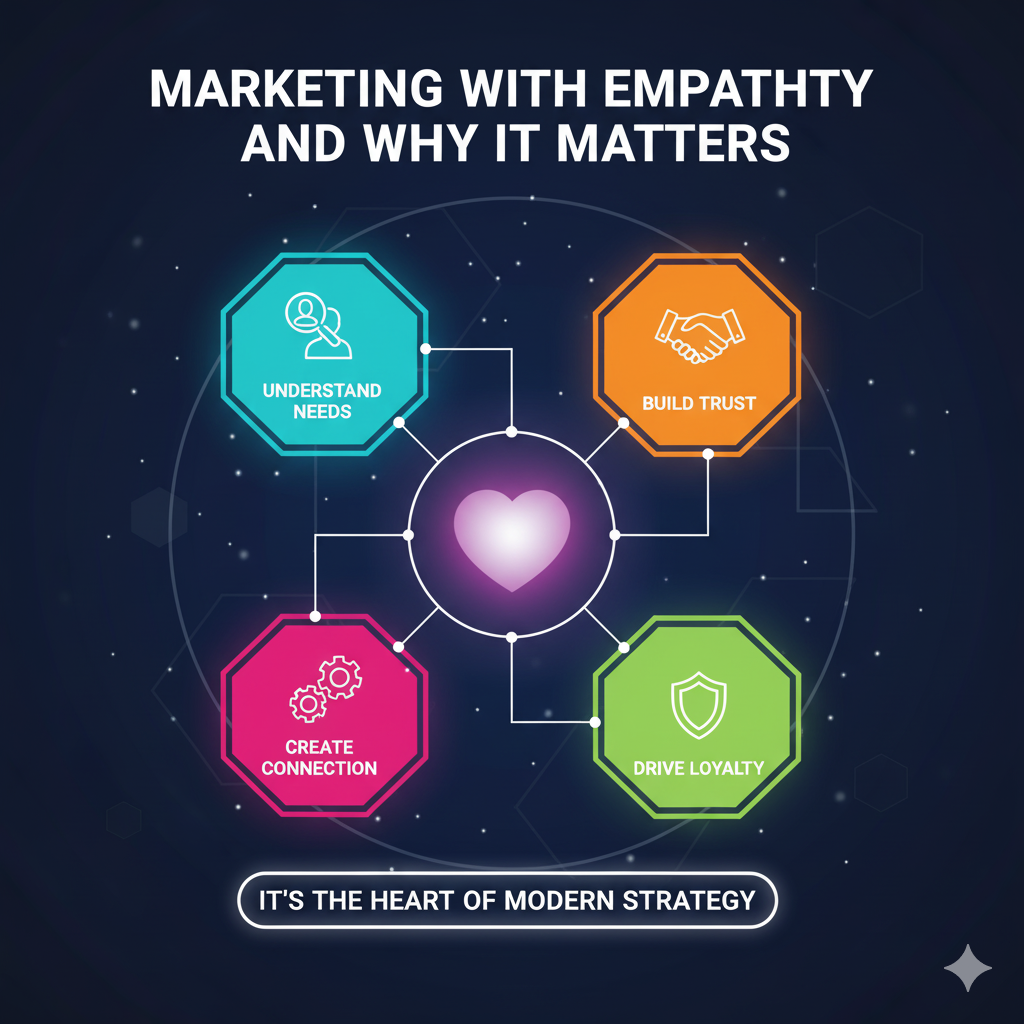
Empathy is a choice, and it’s a vulnerable choice. Because in order to connect with you, I have to connect with something in myself that knows that feeling.
Every truly transformative marketing strategy shares one fundamental element—emotion. The ultimate goal isn’t just to inform customers but to inspire them, to make them feel authentically passionate about your brand’s mission and values. Only through this emotional resonance can you hope to build a meaningful, lasting connection with your audience. And only then will they be genuinely motivated to support you, advocate for you, and welcome you into their lives.
Traditionally, many marketers operated under the assumption that unshakeable confidence was the primary key to forming this relationship. The prevailing wisdom suggested that by being assertively authoritative, you’d prove your market worth. By telling your customers what they needed, they would learn to trust you to deliver the solution.
READ MORE:
Empathy-Based Marketing: Empathy-Based Marketing – markempai.com
Empathy Maps: A Complete Guide: Empathy Maps: A Complete Guide – markempai.com
Why Empathy in Marketing Is More Important Than Everything Else: Why Empathy in Marketing Is More Important Than Everything Else – markempai.com
However, a paradigm shift in consumer psychology and marketing effectiveness reveals that flipping this script produces dramatically better results. Rather than projecting unwavering certainty, it may be far more effective to embrace the empathetic route. This means cultivating a genuine sensitivity to customers’ nuanced needs, considering their unique worldviews, and acknowledging the complex realities of their daily lives.
What is Empathetic Marketing? A Strategic Definition
Empathetic marketing is a deeply consumer-focused strategy rooted in the principles of emotional intelligence. It involves the disciplined practice of putting yourself in your customers’ shoes, learning to think like them and not just for them. This cognitive and emotional shift allows you to discover your customers’ authentic, often unarticulated issues and strategically position your brand as a genuine solution to their core problems.
Rather than preaching from a position of assumed authority, empathy is fundamentally about listening with intent. It’s a supportive, partnership-oriented approach that makes customers feel genuinely seen, heard, and understood. This is not a passive activity but an active strategy that requires systematic implementation.
Dr. Helen Riess, a psychiatrist and author of The Empathy Effect, breaks down empathy into three crucial components that marketers can operationalize:
- Cognitive Empathy: Understanding what a customer is thinking and their perspective.
- Emotional Empathy: Feeling what a customer is feeling, creating shared emotional experience.
- Empathic Concern: The motivation to help and care for the customer’s well-being.
The Multifaceted Benefits of Empathetic Marketing: Evidence and Examples
1. Empathy Puts Your Customers First, Driving Authentic Connection
The most significant strength of empathetic marketing is its radical reorientation toward the customer. By consciously stepping outside your own biases and preconceived notions, you become more attuned to their actual needs, stripping away organizational ego from the creative process.
Over time, this practice allows marketers to develop a more nuanced understanding of the real challenges customers face. The powerful benefit is the ability to position your brand not just as a vendor, but as a dedicated solution-provider. A notable, data-backed example of this is Dove’s “Real Beauty” and “Ad Makeover” marketing campaigns.
Recognizing the profound psychological effect that fat-shaming and unrealistic beauty adverts had on customers’ self-esteem, Dove courageously revamped their entire visual identity. They committed to more diverse, realistic representation and even involved customers directly in deciding on brand messaging. The results were staggering: Dove found that 71% of women felt more beautiful and confident as a direct result of this empathetic marketing initiative, and the campaign generated an estimated $30 billion in sales over a decade, proving that principle and profit are not mutually exclusive.
2. Empathy Fosters Radical Transparency and Builds Trust
The modern consumer is an investigator. They demand to know who they are buying from, questioning how and where a product is made, and to what ethical and quality standards. Empathetic marketing provides a powerful framework for answering these questions with radical honesty.
Take the cosmetic retailer LUSH as a prime example. The company created the “How It’s Made” campaign, publishing detailed articles and videos on its site that gave customers an intimate, unvarnished look at the origins of its products. They didn’t shy away from complex topics like sourcing difficulties or environmental trade-offs.
Furthermore, the company openly discusses worker conditions, pays a living wage, and champions ethical buying. This allows conscientious customers to feel comfortable supporting the brand, knowing that their purchase aligns with their values. A 2024 Stackla report found that 76% of consumers say authenticity is important when deciding which brands they like and support. By dropping the corporate facade, you can include customers in more meaningful conversations, appearing far more relatable and worthy of support.
3. Empathy Empowers Customers, Respecting Their Autonomy
True empathetic marketing respects and caters to the full spectrum of customer circumstances and emotional states. It empowers them to control their brand interactions, demonstrating that you value their well-being over a short-term conversion.
The most basic example is the ubiquitous opt-out option for emails, SMS, and postal messages. While this might seem counterintuitive—why make it easy for customers to ignore you?—it’s a profound act of respect. A marketing message that feels exciting to one customer can be insensitive or deeply painful to another.
Consider holiday celebrations. While Mother’s and Father’s Day campaigns can be highly lucrative, they can be emotionally triggering for people who have suffered loss, have difficult family relationships, or are struggling with infertility. A relentless barrage of celebratory emails can feel tone-deaf and alienating.
Brands like Cardhop and Bombas have addressed this with empathy. They provide clear, easy opt-outs for specific holiday campaigns and acknowledge the complexity of these days in their messaging. Simply recognizing a customer’s lived experience is a powerful way to demonstrate support. These customers may not convert today, but they will remember your brand’s sensitivity and are more likely to return when the time is right for them.
4. Empathy Can Save You from PR Disasters and Guide Crisis Management
While it is always best to use empathetic marketing proactively, it also serves as an essential reactive strategy during crises. When your brand faces a significant problem, pivoting to an understanding, vulnerable strategy can help avert disaster and even strengthen brand perception.
Instead of being defensive, Airbnb took swift, empathetic action. They updated their policies to be more inclusive, funded independent research on bias in sharing economies, and launched a powerful global campaign called “#WeAccept.” The campaign was a call-to-action for inclusivity and a celebration of diversity, directly acknowledging that hosts and travelers come from vastly different backgrounds.
The results were telling: the site saw a 13% increase in brand perception following the campaign, and over 15,000 volunteers signed up to help provide housing for displaced populations through their Open Homes program. This demonstrated that empathetic marketing isn’t about being perfect; it’s about being accountable and committed to growth. As Paul J. Zak’s neuroeconomics research has shown, “Trust and empathy trigger the release of oxytocin, which motivates cooperation.”
The Neuroscience Behind Empathy: Why It Actually Works
The effectiveness of empathetic marketing isn’t just anecdotal; it’s biological. Neuroscientist Antonio Damasio’s landmark research with patients who had damage to the emotional centers of their brains revealed a startling discovery: when emotions are impaired, so is decision-making.
His work, detailed in Descartes’ Error, proved that we are not rational beings who sometimes feel; we are feeling beings who sometimes rationalize. Every decision, including purchasing decisions, is grounded in emotion. Logic is then used to justify the emotional choice. Empathetic marketing works because it speaks directly to the emotional brain, building the neural pathways of trust and connection that precede logical justification.
Implementing Empathy: A Practical Framework
To move from theory to practice, marketers can use the Empathy Mapping technique, a tool used in design thinking to gain a deeper insight into customers. It involves collaboratively mapping out what your customer:
- Says: What are their quotes and direct statements?
- Thinks: What are their worries, aspirations, and thoughts they might not voice?
- Feels: What are their emotional states (frustrated, excited, anxious)?
- Does: What actions and behaviors do they exhibit?
Some Final Thoughts: The Balance of Authentic Empathy
Empathy is a powerful, evidence-based way to reach your customers on a human level. You’re forging a deeper, more resilient connection by genuinely understanding their viewpoints and opening yourself up to new ideas and feedback. Over time, this consistent practice fosters the mutual trust and loyalty that forms the foundation of sustainable business growth.
After all, marketing at its highest level has always been, and will always be, about the customers.
FAQ: Empathetic Marketing
Further Reading & Research:
- Empathy-Based Marketing: Empathy-Based Marketing – markempai.com
- Empathy Maps: A Complete Guide: Empathy Maps: A Complete Guide – markempai.com
- Why Empathy in Marketing Is More Important Than Everything Else: Why Empathy in Marketing Is More Important Than Everything Else – markempai.com
- Why Empathy in Marketing Is Important: Why Empathy in Marketing Is Important – markempai.com
- Why Empathy in Marketing Matters More Than Ever: An Evidence-Based Guide: Why Empathy in Marketing Matters More Than Ever: An Evidence-Based Guide – markempai.com
- The Importance of Empathy in Marketing: The Importance of Empathy in Marketing: A Three-Part Series – markempai.com
- Developing an Empathetic Marketing Strategy: A Framework for Authentic Connection: Developing an Empathetic Marketing Strategy: A Framework for Authentic Connection – markempai.com
- Empathy in Marketing: The Definitive Guide to Connecting With Customers & Driving Unshakeable Brand Loyalty:Empathy in Marketing: The Definitive Guide to Connecting With Customers & Driving Unshakeable Brand Loyalty – markempai.com
- Empathetic Marketing: The Power of Empathy in Advertising That Builds Unbreakable Brand Loyalty: Empathetic Marketing: The Power of Empathy in Advertising That Builds Unbreakable Brand Loyalty – markempai.com
- The Role of Empathy in Modern Marketing: How Emotional Intelligence Drives Sustainable Business Success: The Role of Empathy in Modern Marketing: How Emotional Intelligence Drives Sustainable Business Success – markempai.com
- Empathetic Marketing: The Ultimate Guide to Building Authentic Customer Connections in 2025: Empathetic Marketing: The Ultimate Guide to Building Authentic Customer Connections in 2025 – markempai.com
Ready to Transform Your Marketing Through Empathy?
If you’re ready to harness the proven power of empathetic marketing, the team at Markempai is here to help. With our unique blend of psychological insight, strategic rigor, and creative excellence, we deliver measurable results that strengthen both your brand and your bottom line.
markempai.com |info@markempai.com