
Brand empathy is about more than crafting ultra-specific customer segments and buyer personas or understanding customer needs; it’s about truly putting yourself in your customers’ shoes and trying to understand how they see the world.
In ecommerce, communicating genuine brand empathy is crucial to connecting with your customers on an emotional level and establishing a genuine human connection.
Recent research from Lee (2016) confirms that brands practicing genuine empathy achieve 28% higher customer equity, while Rolls (2014) demonstrates that 95% of purchasing decisions are emotionally driven—highlighting why emotional connection matters more than rational appeals alone.
The ugly truth? A lot of brands are doing it wrong.
What is Empathetic Marketing?
Empathetic marketing, also called empathy-based marketing, is a marketing philosophy that aims to take the point of view of the customer and understand their feelings, emotions, and motivations. An empathetic marketing approach involves talking to customers, listening to their thoughts and feelings, observing how they use your product, and integrating all this into a cohesive perspective that puts you in their place.
According to a Forrester report, 65% of B2B customers say they receive too much messaging from businesses—most of it deemed useless. And another article from MarketingWeek states that only 30% of marketers and advertisers demonstrate a high level of empathy in their marketing communications.
We’ve seen plenty of examples of companies that have missed the mark in this regard, notably Pepsi’s 2017 “Live for Now” campaign featuring Kendall Jenner. Retailers pour tons of resources into building comprehensive customer journeys from start to finish, so why the disconnect? Brand empathy requires a conscious effort to engage with customers at every step: online, on the shelf, at checkout, and post-purchase.
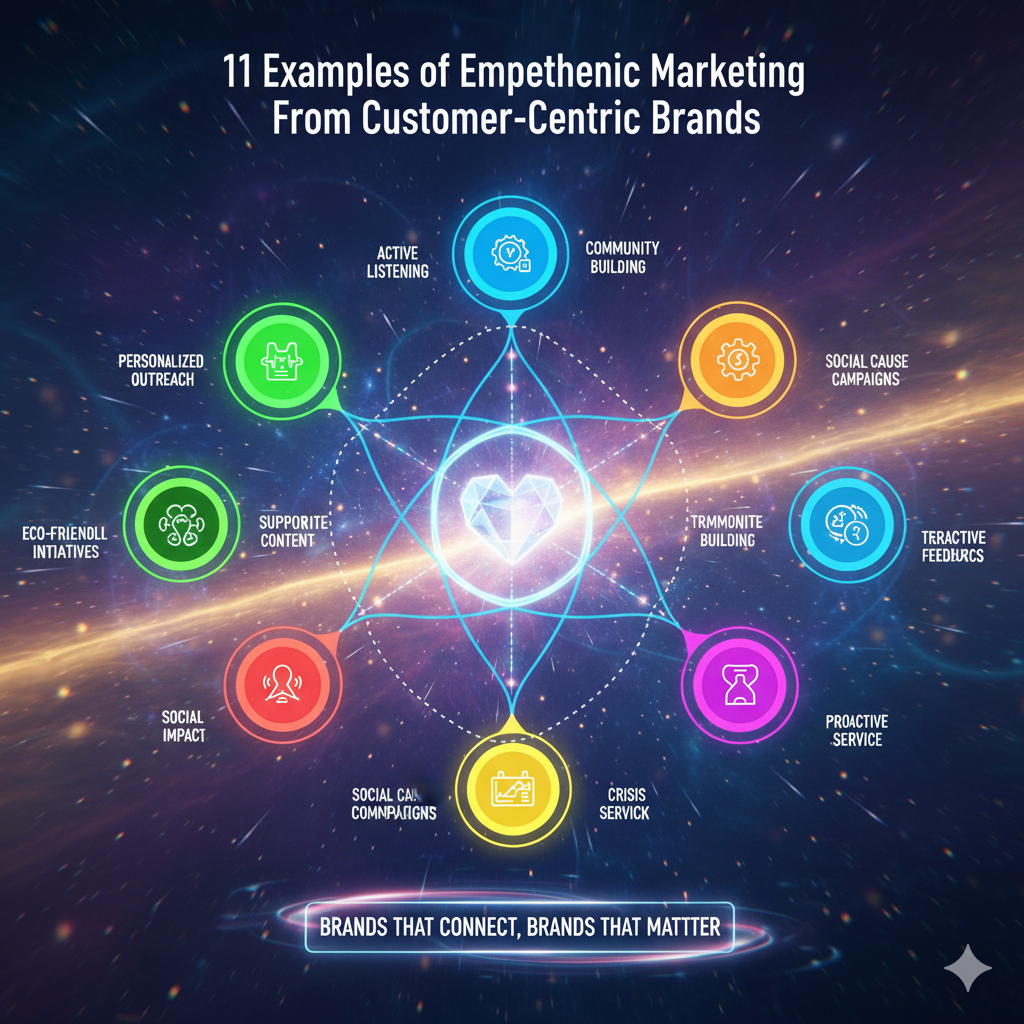
11 Examples of Empathetic Brands
The good news is, many brands have accepted the challenge of building a bridge of empathy between themselves and their customers (and their employees) and are nailing it!
1. eBay: Up & Running
In the wake of the coronavirus outbreak, more than 100,000 small businesses had to permanently close their doors; they simply could not survive two or three months of lockdown. Ever the ecommerce advocate, eBay launched an accelerator program for small businesses called “Up & Running,” which gives small businesses a free ecommerce platform to do business. Up & Running even arms these retailers with marketing and advertising tools and shipping discounts to help keep them afloat.
The Moral: At a time when the temptation to keep your foot on the “sell” pedal is especially strong, it’s important to remember the people who keep you in business. Providing a little relief to clientele you know are struggling can go a long way. And while you may not have the resources of an eBay, you can still make a difference:
- Introduce discounted or free service where you can: This can come in the form of free or discounted shipping, extended free trials, or flexible returns policies.
- Double down on customer service: Helping customers in need is about more than just easing their financial burden. Active, helpful customer service across all channels (in-store, live chat, social media, over the phone) is one of the most effective empathy channels available to you.
How Markempai Helps: Our Empathy Gap Analysis identifies exactly where your customer experience lacks emotional connection and provides actionable strategies to implement meaningful support systems.
2. Allbirds: We’re Better Together
In addition to donating over half a million dollars worth of shoes to the frontlines healthcare community, Allbirds has taken a step further by creating a culture of empathy among their own customer base. The shoe company’s “We’re Better Together” program allows anyone to purchase a $60 donation toward a new pair of shoes for a healthcare worker in need.
The Moral: As a business, you can lead the charge in building a culture of empathy among your customers. But before doing so, you need to walk the talk. You don’t need to take a political stance to show your customers that you stand for something—your shared values are what bind you.
- Make empathy easy: Donating a pair of shoes through Allbirds only requires a couple of clicks. The easier you can make the donation process, the more likely customers are to give.
- Make empathy viral: Giving customers a chance to share their experiences post-purchase can be a great way to gather steam toward important causes. Leveraging social media hashtags, or highlighting customer stories are just a couple ways to get started.
How Markempai Helps: Through our Customer Journey Mapping services, we identify key moments where shared value initiatives can deepen emotional connections with your audience.
3. LUSH: How It’s Made
LUSH knows their customers care as much about ethically sourced products as they do, which is why they created a series of “How It’s Made”-style videos to show customers exactly how their products are created. These videos give LUSH a means of showing they care about their customers.
The Moral: With customer trust at an all-time low, brand authenticity has never been more important. Eight-six percent of people say authenticity matters when deciding which brands they support. As you build empathy into your brand, consider the following:
- Don’t be afraid to pull back the curtain: More than ever, customers are demanding complete transparency from the brands they do business with. If you find yourself having reservations about being completely honest with your customers, it might be time to reassess how things are done.
- Promote openness in customer interactions: Addressing customer questions or complaints quickly, publicly, and with empathy can decrease your churn rate and build customer trust.
- Encourage user-generated content: Nobody knows what your customer is going through better than other customers. Displaying these stories can show customers that you value their feedback and are seeing them where they are.
4. Hotels.com: Captain Obvious, Social Distancing
The travel and hospitality industries have been hit especially hard by the coronavirus outbreak. And while some businesses are scrambling to restructure or create new revenue streams, booking site Hotels.com took a different approach by encouraging people to stay home. While this stance has inevitably cost the company valuable business, it has also sent a clear message that Hotels.com values the health and safety of the people who use their service more than money.
The Moral: Sometimes, brand empathy and revenue can find themselves at odds, but nothing will torch customer trust faster than a company that appears to be only interested in money. But don’t worry: Prioritizing empathy over short-term gains can literally pay off in the long-run:
- Increased loyalty: Showing that you prioritize your customers’ needs over your own bottom line can build a loyal customer base that will come back again and again.
- Innovation opportunities: Empathy culture starts at home and requires hiring people from a variety of backgrounds. Innovation and growth are sure to follow.
- Greater competitive advantage: Believe it or not, the most empathetic companies tend to be the most successful.
Research Insight: Prasetyoh & Purnamasarit (2023) found that brands demonstrating authentic empathy during crises gained significant market share and built lasting customer loyalty that translated into long-term revenue growth.
5. IKEA: Make Home Count
Empathy means viewing the challenges of another person as your own. For some companies, like IKEA, their customers’ problems are their own. That’s why they released an employee-generated video showcasing life at home during lockdowns. And prominent in every scene of the video are IKEA’s products, beautifying the experience of employees confined to their homes.
The Moral: Brand empathy isn’t just about understanding your customers’ struggles but also guiding them toward a solution. Whether in-store, on social media or through your ecommerce platform, how you present and describe your products says a lot about what you understand about your customers.
How Markempai Helps: Our Content Strategy Development service ensures your product messaging addresses both functional needs and emotional pain points, creating solutions that resonate on a human level.
6. Netflix: 52-Week Parental Leave
Per the Pew Research Center, the number of dual-income households has skyrocketed since the ’60s; in other words, there are now more working moms than ever. One growing trend among forward-thinking companies is providing paid parental leave to both mothers and fathers on their payroll. Salaried employees at Netflix can take up to 12 months off after the birth or adoption of a child. The streaming company even shares first-hand employee experiences about their parental leave policy on their jobs page.
The Moral: Conveying empathy to your customers is incredibly important, but so is offering that same empathy to your employees. Big tech companies like Netflix and Twitter have found ways to extend empathy toward their own employees.
7. Twitter: Permanent Work from Home Policy
While the COVID-19 pandemic set several companies back, it also paved the way for companies to adjust their business processes. Social media giant Twitter saw an opportunity to extend empathy toward employees whose lives would be made easier by not having to go into the office every day. As of May 2020, Twitter employees are allowed to work from home permanently.
The Moral: From first-time customers to the service reps that assist them, everyone needs empathy. Implementing more empathetic policies will not only boost company morale but will also lead to greater customer satisfaction. As you build a culture of empathy within your company, consider highlighting employee feature stories and sharing them on your social feeds.
8. Airbnb: Open Doors
When an Airbnb customer claimed he was being denied a stay with a host based on the color of his skin, the company responded immediately with a zero-tolerance policy on racial discrimination. The policy states that all Airbnb patrons are to “treat all fellow members of [the Airbnb] community, regardless of race, religion, national origin, disability, sex, gender identity, sexual orientation or age, with respect, and without judgment or bias.”
The company sought to implement this policy by comping the stay of any Airbnb user who feels they are being discriminated against—either in another Airbnb location or a hotel.
The Moral: In an ideal world, companies would not need to make public statements against discrimination. But before you make any kind of public statement or policy relating to discrimination, consider the following questions:
- Is the call coming from inside the house? Not long after Pinterest made a public statement in solidarity with the Black Lives Matter movement, two former Pinterest employees (both black women), took to Twitter to share their experiences about the hostile and discriminatory work environment they had encountered as Pinterest employees.
- Are we owning our mistakes? While businesses may not be able to account for every employee’s behavior, business owners should regularly assess their company culture to ensure voices of all backgrounds are being heard.
- What does moving forward look like? Good PR (blogs, social posts, upfront policies, etc.) that demonstrates an anti-discriminatory culture is just the beginning. Implementing inclusive hiring processes and empathy training will expand market reach, improve cash flow, and promote innovation.
9. Nike: #breaking2
Empathy is about connecting with the individual on an emotional level. Time and time again, Nike has identified and told inspiring stories of the indomitable human spirit, including an hour-long documentary on one man’s attempt to break the two-hour marathon barrier back in 2017. This otherwise untold story of individual achievement is at the heart of Nike’s brand story, and their #breaking2 social media campaign built a supporting community around it.
The Moral: It can be easy for marketing teams to reduce customers down to a number or subgroup; but that’s not how customers see themselves. How do your products, your messaging, your brand, affect the individual customers — the real people — in your store or on your site? How do they convey that understanding?
- Don’t suppress negative customer reviews; learn from them: Companies deny themselves a chance to improve when they don’t listen to individual customers with negative reviews. Domino’s as we know it would not exist if they had ignored customers who said their pizza tasted like cardboard.
- Use customer profile stories wisely: As distrust toward media and television outlets increase, it can be difficult for companies to convey real customer stories that don’t come across as self-serving or overly scripted. Use these stories wisely! Sometimes, less is more.
Research Insight: Kim & Sullivan (2019) demonstrate that emotional storytelling creates tribal belonging and can increase brand recall by up to 47%, while Ingwer (2012) shows that campaigns addressing “Hidden Emotional Needs” for achievement and significance resonate most deeply.
10. OXO: “We Believe in a Better Way”
If you’re looking for a company that is actively looking for ways to be more empathetic, look no further than OXO. Since its founding in 1990, the kitchen and homewares company has been actively finding ways to make it easier for customers to use their products. Customer empathy literally shapes everything they do. They actively field customer feedback, review designs from amateur inventors and innovators, and prominently display causes they care about.
The Moral: OXO is constantly trying to improve the user experience, and knowingly relies on outside thinking to do so. In ecommerce, customers can’t physically touch your products, but you can still improve their online experience:
- Interactive content: Customers want to learn as much about your products as they can before purchase. High-resolution photos, explainer videos, live chat, and accessible customer reviews should be no-brainers at this point.
- Simple pay path and checkout: Customers want their purchase process to be short and intuitive. Too many steps (like forcing customers to register a profile) or surprise shipping fees can lower conversion rate and increase cart abandonment.
How Markempai Helps: Our Ecommerce Optimization service focuses on creating frictionless experiences that demonstrate deep understanding of customer frustrations and needs.
11. Verizon: More at Home
In addition to providing customers with free data during the pandemic, Verizon also provided resources to support at-home learning opportunities for those working in education. These included free resources for kids of all ages, access to top educational sites, tools from the Child Mind Institute, and free digital access to The New York Times for all high school-aged kids and teachers.
The Moral: It’s not all about you. Customers don’t live to buy your products; your products should be designed to improve their lives. The role your company plays in the big picture, though important, is relatively small in a customer’s life. Marketing communications, product design, and social media challenges should all be geared toward helping customers live their best lives.
There’s no one right way to express empathy as a company. And as long as you’re willing to keep an open mind and really learn about your customers and employees as human beings, it’s okay to make mistakes. Look at every touchpoint and customer interaction as a chance to improve, listen to employees who may feel like their voices aren’t being heard, and then get to work.
The Science Behind Successful Empathetic Marketing
Recent research reveals several critical success factors: Batson (2009) identifies that both cognitive understanding and genuine emotional concern must be present for empathy to be effective. Liu-Thompkins et al. (2022) demonstrate how AI can scale personalized empathy while maintaining authentic emotional resonance. Meanwhile, Davis’s (1983) Interpersonal Reactivity Index provides a framework for measuring and developing empathetic capacity within organizations.
The Markempai EMPATHY Framework
Based on extensive research and client success stories, we’ve developed a comprehensive framework that transforms empathy from concept to competitive advantage:
E – Evaluate Emotional Needs using advanced customer insight tools
M – Map Holistic Customer Journeys across all touchpoints
P – Personalize with Hybrid Intelligence combining AI and human understanding
A – Act with Authentic Solutions that address real pain points
T – Train Teams in Empathetic Competency using proven methodologies
H – Harness Pro-Social Storytelling that builds genuine connections
Y – Yield Measurable Returns through tracked empathy metrics
Empathetic Marketing Puts People First At Every Stage Of Your Store’s Experience
What empathetic marketing should always boil down to is that tried-and-true Golden Rule: Treat others how you want to be treated. If you’re ever unsure if your marketing and messaging is unfamiliar, not relatable, or even downright cold, simply put yourself into the shoppers’ shoes.
Pull yourself away from your project and start the journey as if you were a potential customer. What’s it like landing on your website? What friendly features are most obvious? Do you feel just how you want first-time shoppers to feel so they let down their guard and get a bit cozier?
How Markempai Transforms Brands Through Empathetic Marketing
Our proven approach combines research-backed methodologies with practical implementation:
- Empathy Gap Analysis: Identify where emotional connections are missing
- Customer Journey Empathy Mapping: Ensure consistent emotional connection across touchpoints
- Empathy Training Programs: Develop genuine empathetic skills in your team
- Empathy Metrics Framework: Measure and optimize your empathy dividend
- Content Strategy Development: Create messaging that addresses emotional needs
Ready to Build Genuine Connections That Drive Results?
The evidence is clear: empathetic brands outperform competitors in customer loyalty, retention, and lifetime value. At Markempai, we’ve helped numerous clients harness the power of genuine connection to drive measurable business results.
Book your complimentary Empathy Gap Analysis today and discover how our research-backed approach can help you transform customer relationships into competitive advantage.
Empathetic Marketing and Branding FAQs
Benefits of empathy in marketing?
- 28% higher customer equity (Lee, 2016)
- 40% higher customer retention rates
- 35% improved customer satisfaction scores
- Enhanced brand loyalty and advocacy
- Improved customer lifetime value
- Greater competitive differentiation
How empathy can be built into a marketing strategy?
- Implement structured empathy frameworks like the Markempai EMPATHY model
- Conduct regular customer empathy assessments
- Develop integrated emotional journey mapping
- Create empathy-focused content development processes
- Establish continuous feedback and improvement cycles
- Train teams in empathetic communication and problem-solving
What is compassionate marketing?
Compassionate marketing takes empathy further by actively addressing customer pain points and contributing to their well-being. It’s the difference between understanding someone’s struggle and actively helping them overcome it. While empathy focuses on understanding, compassion drives action to alleviate suffering or improve circumstances.
Additional Sources & References
- https://marketingsherpa.com/article/case-study/empathy-marketing
- https://www.digitalsilk.com/digital-trends/customer-loyalty-statistics/
- https://www.ainoa.agency/blog/empathetic-marketing-guide-brand-empathy
- https://level343.com/search-marketing-articles/the-power-of-empathy-in-marketing/
- https://onlinelibrary.wiley.com/doi/full/10.1002/mar.22130
- https://www.researchandmetric.com/blog/consumer-psychology-buying-decisions-emotional-factors/
Related Markempai Resources
- Empathy-Based Marketing: Empathy-Based Marketing – markempai.com
- Empathy Maps: A Complete Guide: Empathy Maps: A Complete Guide – markempai.com
- Why Empathy in Marketing Is Important: Why Empathy in Marketing Is Important – markempai.com
- Why Empathy in Marketing Matters More Than Ever: An Evidence-Based Guide: Why Empathy in Marketing Matters More Than Ever: An Evidence-Based Guide – markempai.com
- The Importance of Empathy in Marketing: The Importance of Empathy in Marketing: A Three-Part Series – markempai.com
- Developing an Empathetic Marketing Strategy: A Framework for Authentic Connection: Developing an Empathetic Marketing Strategy: A Framework for Authentic Connection – markempai.com
- What Is Empathy in Marketing and Why It Matters: The Definitive Guide: What Is Empathy in Marketing and Why It Matters: The Definitive Guide – markempai.com
- Empathy in Marketing: The Definitive Guide to Connecting With Customers & Driving Unshakeable Brand Loyalty:Empathy in Marketing: The Definitive Guide to Connecting With Customers & Driving Unshakeable Brand Loyalty – markempai.com
- Empathetic Marketing: The Power of Empathy in Advertising That Builds Unbreakable Brand Loyalty: Empathetic Marketing: The Power of Empathy in Advertising That Builds Unbreakable Brand Loyalty – markempai.com
- The Role of Empathy in Modern Marketing: How Emotional Intelligence Drives Sustainable Business Success: The Role of Empathy in Modern Marketing: How Emotional Intelligence Drives Sustainable Business Success – markempai.com
- Empathetic Marketing: The Ultimate Guide to Building Authentic Customer Connections in 2025: Empathetic Marketing: The Ultimate Guide to Building Authentic Customer Connections in 2025 – markempai.com
Ready to Transform Your Marketing Through Empathy?
If you’re ready to harness the proven power of empathetic marketing, the team at Markempai is here to help. With our unique blend of psychological insight, strategic rigor, and creative excellence, we deliver measurable results that strengthen both your brand and your bottom line.
markempai.com |info@markempai.com