
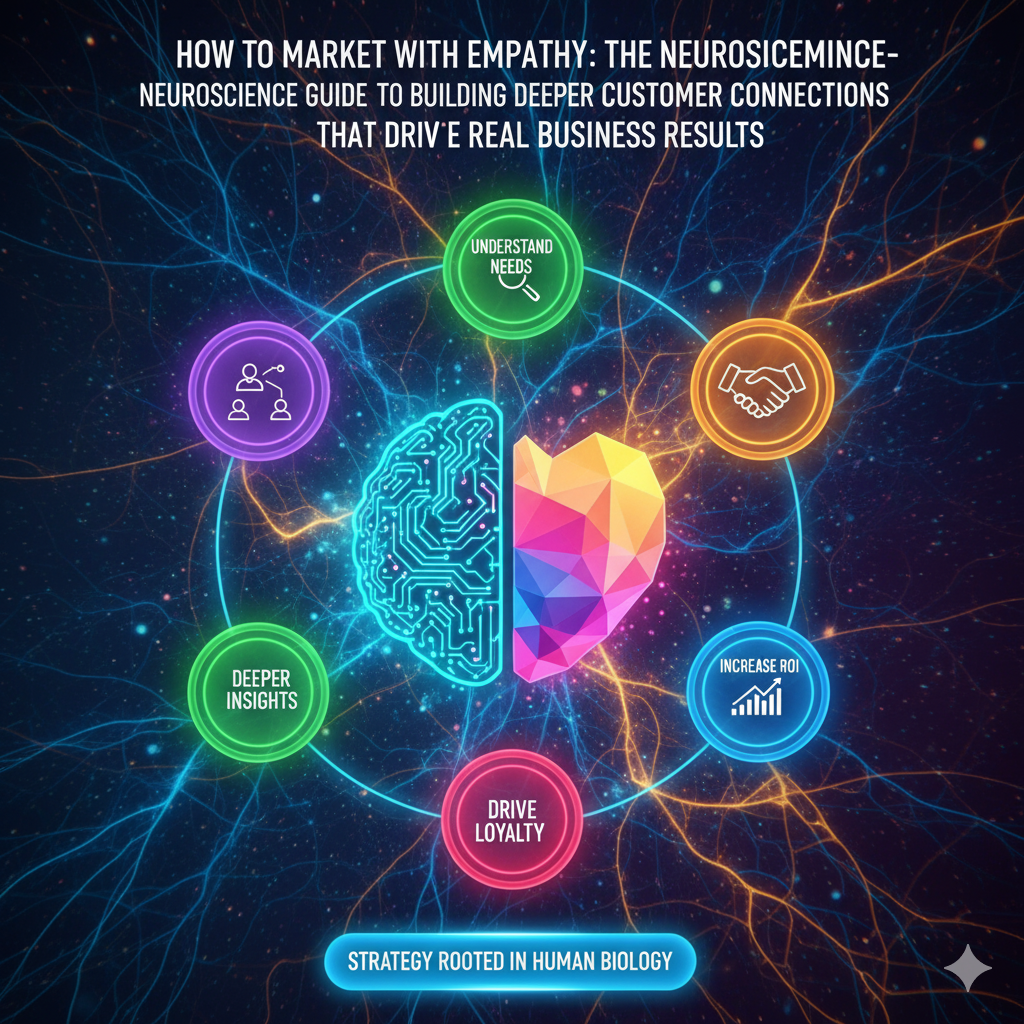
You’ve invested considerable resources into campaign optimization, brand messaging refinement, and data analysis—yet the meaningful connection with your audience remains elusive.
The disconnect often stems from a fundamental oversight: how your audience genuinely feels about your brand and communications.
This is where empathetic marketing becomes transformative. Rather than treating customers as transaction endpoints, empathetic marketing places customers’ emotional needs, pain points, and aspirations at the center of all marketing decisions. The research is unequivocal: consumers prioritize emotional resonance over purely rational considerations.
This comprehensive guide explores how empathetic marketing builds sustainable competitive advantages, supported by neuroscience research, consumer psychology, and real-world case studies demonstrating measurable business results.
The Neuroscience Behind Emotional Decision-Making
Why Emotions Trump Logic
The human brain processes emotional stimuli approximately 3,000 times faster than rational thought. The limbic system—your brain’s emotional center—activates long before the neocortex engages in logical analysis, essentially predetermined purchasing decisions before conscious evaluation occurs.
Neuroscientist Antonio Damasio’s groundbreaking Somatic Marker Hypothesis revolutionized our understanding of decision-making. Damasio demonstrated that emotions are not ancillary to decision-making but biologically essential. “Somatic markers” are physiological responses—elevated heart rate, nausea, tension—that the brain uses as shorthand signals to evaluate choices quickly in complex, uncertain situations. Without these emotional signals, individuals become cognitively overwhelmed, requiring exhausting cost-benefit analyses for every decision.
Research using fMRI neuroimaging confirms this theory: when consumers are exposed to their preferred brands, the brain’s reward center—specifically the nucleus accumbens—activates with the same intensity as responses to addictive substances. This neurological connection explains why emotionally charged marketing consistently outperforms rational, feature-focused messaging.
The statistic often cited in marketing literature bears repeating: 95% of purchasing decisions occur subconsciously through emotional rather than rational processes. More nuanced research reveals that 86% of consumers’ buying choices are influenced by an average of ten emotional needs, ranging from desires for self-worth to motivations affecting how others perceive them.
The Emotional Drivers Behind Purchasing Behavior
Recent consumer psychology research identifies a clear hierarchy of emotional triggers that consistently influence purchasing decisions:
Primary Emotional Drivers: Fear of missing out (FOMO) accounts for 60% of impulse purchases, particularly in digital commerce and limited time offers. This primal fear taps into evolutionary needs for resource acquisition and social belonging, creating urgency that bypasses rational deliberation. Trust and security represent foundational emotions in purchase decisions, especially for high-value items or services requiring long-term commitment. Research indicates that 83% of consumers require emotional validation through reviews, testimonials, or brand reputation before making significant purchases.
Secondary Emotional Influencers: Pride and status enhancement drive luxury purchases, with 72% of premium product buyers citing emotional satisfaction rather than functional superiority as their primary motivation. Belonging and community connection increasingly influence purchases in our socially connected world. Brands that successfully create tribal identities see 3x higher customer lifetime value compared to those focusing solely on product features.
The Empathy Gap: A Critical Market Inefficiency
Despite the clear importance of empathy, a significant gap exists between customer expectations and brand delivery:
- 68% of customers expect brands to demonstrate empathy, yet only 37% of customers say brands generally demonstrate empathy
- 68% of customers will spend more money with a brand that understands them and treats them like individuals
- 66% of customers expect companies to understand their unique needs and expectations, but only 34% of companies generally treat customers as unique individuals
This “empathy gap” represents a substantial opportunity for differentiation. Over 90% of U.S. consumers plan to switch brands, meaning loyalty is increasingly conditional rather than habitual. Brands demonstrating economic empathy achieve 34% higher retention rates during downturns by positioning themselves as financial allies rather than vendors.
The Business Case for Empathetic Marketing
Proven ROI Metrics
The business impact of empathetic marketing extends far beyond customer satisfaction scores. Organizations implementing structured empathy frameworks achieve measurable returns across multiple performance indicators:
Customer Retention and Lifetime Value: Companies implementing structured empathy frameworks achieve 40% higher customer retention rates and 35% improved customer satisfaction scores. Empathetic brands achieve 28% higher customer equity, a comprehensive measure encompassing retention, acquisition, and profitability. These metrics directly translate to revenue: research from Qualtrics demonstrates that customers rating experiences 5/5 stars are more than twice as likely to repurchase, and 80% of satisfied consumers spend more with brands that understand them.
Brand Recall and Engagement: Brands that master emotional connection see up to 47% higher brand recall. When customers feel heard and understood, they transform from passive recipients of marketing messages into active brand advocates. Companies that maintain or increase marketing spend during economic downturns—particularly through empathy-driven communications—emerge stronger when the economy recovers, gaining around 4.3% increase in profits compared to brands that cut costs.
New Customer Acquisition: Understanding customers’ wants enables compelling messaging that attracts new audiences. When empathetic messaging resonates with a company’s target audience, it creates social proof and positive word-of-mouth. This is particularly valuable during budget constraints when earned media becomes disproportionately valuable.
The Neuroscience of Brand Love
Empathetic marketing doesn’t just improve metrics—it creates what researchers call “brand love,” a neurological and emotional state where customers exhibit the same commitment patterns as personal relationships. Brand experiences that address emotional needs create positive activation in brain regions associated with personal identity and social bonding, transforming customers into brand evangelists who voluntarily amplify marketing messages.
Understanding Consumer Emotional Needs
The Six Core Emotional Needs
Marketing theorist Mark Ingwer identifies six foundational emotional needs that drive consumer behavior:
Control: Satisfying consumers’ need for control provides the greatest potential for building loyalty through intrinsic motivation. Apple exemplifies this principle through iTunes and the App Store, handing music and device customization control directly to users. Each iPhone becomes unique and irreplaceable, creating psychological switching costs far exceeding price considerations.
Self-Expression: Consumers seek to express their identity through purchases. Brands that enable self-expression—whether through customization, community participation, or values alignment—create emotional investment beyond transactional relationships.
Growth: Consumers desire progress and development. Brands positioning their products as facilitators of personal growth create compelling value propositions addressing intrinsic human motivation.
Recognition: Acknowledgment of achievement and status motivates purchases. Loyalty programs, exclusive membership tiers, and personalized recognition create psychological rewards reinforcing brand relationships.
Belonging: Humans are fundamentally social creatures. Brands creating communities where members feel genuine belonging achieve significantly higher lifetime value through reduced price sensitivity and increased advocacy.
Care: The perception that a brand prioritizes customer well-being over profit creates the foundation for trust. This is particularly powerful during economic uncertainty or personal challenges.
Importantly, research reveals that the more empathetic marketers believe themselves to be, the worse they typically perform at predicting customer reactions, highlighting the critical importance of data-driven empathy rather than assumption-based approaches.
Developing a Structured Empathetic Marketing Strategy
Step 1: Gather Comprehensive Audience Insights
First-Party and Zero-Party Data Collection: Begin by systematically collecting zero-party data—information customers intentionally share through surveys, preference centers, account settings, and feedback forms—alongside first-party data gathered from website analytics, purchase history, email engagement, and transactional data. These direct customer data sources are increasingly valuable as privacy regulations tighten and third-party cookies phase out
The strategic advantage of prioritizing zero-party and first-party data extends beyond privacy compliance. Customers granting explicit data permission demonstrate higher trust and engagement. A consent management platform (CMP) simplifies this collection while improving data quality and regulatory compliance.
Pattern Recognition and Contextual Analysis: Data alone reveals limited insights. Identify behavioral patterns: seasonal fluctuations, regional preferences, engagement anomalies, and customer journey inflection points. An ice cream brand observing summer sales spikes should investigate underlying drivers—is it purely weather-related, or do nostalgia, comfort, and family traditions drive purchases? This contextual understanding enables more precise emotional targeting.
Direct Customer Engagement: Numbers provide what qualitative research cannot. Conduct customer interviews and focus groups exploring day-to-day frustrations, aspirations, decision-making processes, and emotional states. A collaboration tool marketer asking users about daily frustrations uncovers real-life struggles that should guide messaging. These qualitative narratives become the foundation for authentic storytelling.
Creating Empathy Maps: Develop comprehensive customer personas using empathy mapping techniques. The empathy map framework divides customer understanding into sections: ‘Think & Feel’ (expectations, fears, hopes), ‘Hear’ (what others say about your brand), ‘See’ (environmental influences), ‘Say & Do’ (observable behaviors), ‘Pain’ (frustrations and obstacles), and ‘Gain’ (aspirations and desired outcomes). This holistic perspective prevents reductive assumptions about customer needs.
Step 2: Develop Emotionally Resonant Messaging
Craft Core Messages Addressing Emotional Needs: Based on data insights, define the primary challenge your product solves from the customer’s perspective. Avoid sympathy-based language—focus on genuine understanding. Sympathy recognizes emotion; empathy understands the “why” behind emotions. A sympathetic message says, “We’re sorry you’re frustrated.” An empathetic message says, “We understand how frustrating manual data entry feels—we’ve felt that same chaos, and here’s how we solved it.”
Use Relatable, Authentic Language: Replace industry jargon with customers’ own terminology. If your target audience describes spreadsheet work as “chaos,” mirror that language to demonstrate understanding. This vocabulary matching signals that you’ve genuinely listened rather than assumed.
Incorporate Authentic Storytelling: Share narratives of real customers overcoming similar challenges. Authentic brand storytelling builds trust, fosters emotional connections, and helps brands stand out in crowded markets. Effective brand stories feature relatable characters, authentic experiences, clear plot progression, and compelling themes. Storytelling transforms abstract product benefits into lived experiences that viewers can imagine applying to their own situations.
Key storytelling elements include:
- Real characters reflecting your actual customer base rather than idealized personas
- Vulnerability acknowledging challenges and failures rather than projecting infallibility
- Specificity detailing particular situations rather than generic platitudes
- Genuine transformation showing realistic outcomes rather than overselling results
Step 3: Select Appropriate Distribution Channels
Strategic Channel Selection: Rather than appearing everywhere, identify where your target audience actively spends time and engages. Two-way conversations through appropriate channels signal authenticity and demonstrate commitment to connection rather than broadcast messaging.
Social Media Engagement: Social platforms enable real-time conversations that build community. Respond quickly to feedback, acknowledge concerns, and participate in ongoing discussions. Critically, ensure adequate bandwidth exists to maintain authenticity rather than defaulting to generic responses that undermine empathetic positioning.
Email Segmentation and Personalization: Segment email lists by customer type or pain point. First-time buyers might receive supportive onboarding content addressing initial concerns, while loyal customers receive appreciation-based offers and exclusive access. This segmentation demonstrates understanding of different customer circumstances and needs.
Longer-Form Content Strategies: Video, podcasts, and blog content allow deeper exploration of nuanced struggles and solutions. YouTube and long-form written content enable visual and emotional communication—facial expressions, tone of voice, and storytelling depth—that surface-level messages cannot achieve.
Step 4: Implement, Test, and Iterate
Pilot Empathetic Messaging: Rather than enterprise-wide rollout, test more empathetic messaging in one channel—perhaps an email sequence or social campaign—and systematically measure reactions. This approach enables refinement before broader implementation.
Track Early Indicators: Monitor engagement rates, click-through rates, and micro-conversions signaling message resonance. High click-through rates coupled with low conversions might indicate empathetic messaging captured attention but failed to drive action, suggesting refinement in value communication or calls-to-action.
Maintain Openness to Iteration: If initial results disappoint, return to data. Did you misunderstand significant concerns? Were you targeting incorrect emotional triggers? Empathy requires continuous adaptation—market conditions, competitor moves, and seasonal factors constantly shift customer emotional states and needs. Return to data collection, reexamine assumptions, and test refined approaches.
Incrementality Testing: Employ rigorous testing methodologies to isolate empathetic messaging impact from other variables. This advanced approach measures the actual incremental impact of specific messaging changes on desired outcomes, separating correlation from causation.
Step 5: Measure and Communicate Results
Comprehensive Metrics Assessment: Combine quantitative metrics (click-through rates, conversion rates, customer retention rates, customer lifetime value) with qualitative feedback from surveys, interviews, and social listening. This integrated approach validates whether you genuinely addressed customers’ emotional needs.
Sentiment Analysis and Social Listening: Measure brand sentiment by tracking mentions across social platforms, analyzing tone and context, calculating sentiment scores, and monitoring share of voice versus competitors. Advanced tools analyze conversations, trending topics, and overall brand perception, identifying emerging issues, trends, and engagement opportunities. Positive brand sentiment predicts increased loyalty, repeat purchases, and customer advocacy.
Internal Communication and Culture Shift: Share empathetic marketing successes and learnings with stakeholders. Demonstrate how reframing content around customer emotions yielded stronger engagement and loyalty. This internal storytelling builds organizational empathy and encourages customer-centric approaches across departments.
Scale Effective Approaches: When empathetic strategies prove effective, systematically apply them across campaigns and channels. Maintain vigilance for market changes, competitive moves, and seasonal factors requiring adaptations.
Real-World Examples of Empathetic Marketing Excellence
Dove’s Real Beauty Campaign
Dove’s “Real Beauty” campaign fundamentally disrupted beauty industry narratives by featuring “real people” rather than idealized models. Beyond marketing, Dove took the revolutionary step of withdrawing from traditional beauty pageants and celebrity sponsorships. The brand communicated: “We understand your everyday insecurities, and we celebrate you as you are”—validating real feelings rather than offering patronizing pity.
Psychologically, Dove effectively addressed what Ingwer identifies as hidden emotional needs for Significance and Connection. By confronting digital manipulations in the “Beauty in the AI Age” campaign, acknowledging modern anxieties about AI-distorted body perceptions, and reinforcing authentic beauty standards, Dove positioned itself as uniquely understanding contemporary consumer psychology.
Supermetrics’ Honest LinkedIn Messaging
Supermetrics’ “Get Your Sheet Together” LinkedIn campaign tapped into the authentic frustration marketers experience juggling spreadsheets and manual data entry. The brand demonstrated understanding through humor—not condescension—and positioned its solution as relief. The messaging worked precisely because it started with genuine empathy for shared struggle before introducing the product.
Monzo’s Financial Empathy
UK digital bank Monzo revolutionized financial services communication by recognizing anxiety many feel about money. Rather than corporate-speak, Monzo uses everyday language in notifications. The platform offers spending controls for vulnerable customers and gambling blocks with 24-hour cooling-off periods. This approach balances digital efficiency with emotional intelligence, demonstrating that technology and empathy enhance rather than oppose each other.
Waitrose’s Cost-of-Living Response
During the 2022–2023 cost-of-living crisis, Waitrose transformed its marketing approach by creating clearly labeled budget-friendly meal solutions, adjusting loyalty rewards to emphasize immediate value, communicating price locks on essentials transparently, and shifting advertising to quality-to-price ratio rather than exclusivity. By acknowledging financial pressures customers faced—even high-income customers—Waitrose strengthened brand loyalty during economic hardship.
This approach demonstrates “economic empathy” at scale. Rather than aggressively pushing premium offerings, Waitrose positioned itself as a financial ally, achieving significantly better retention than competitors who maintained pre-crisis messaging.
Advanced: When Empathy and Automation Intersect
Artificial Empathy in Customer Service
Recent breakthroughs in affective computing enable chatbots to detect emotional cues, interpret context, and respond with human-like understanding. A basic chatbot says, “We apologize for the delay.” An empathetic chatbot says, “I understand how frustrating this must be,” creating social presence and emotional validation.
However, research provides important nuance: empathetic chatbots enhance customer satisfaction when context permits thoughtful interaction, but may detract from experience when customers face time pressure. The implication is critical—genuine empathy requires recognizing when emotional connection is appropriate versus when efficiency is valued.
A 2024 Zendesk survey found that 71% of customers believe AI can make service more empathetic and 67% want AI delivering empathetic experiences. However, the critical balance involves using AI as a “copilot”—automating repetitive tasks while humans focus on high-value, emotionally intelligent interactions.
The Critical Distinction: Artificial Versus Authentic Empathy
Unlike humans, AI cannot experience true emotional empathy. AI can simulate cognitive empathy—understanding and predicting emotions from data—but cannot experience emotional or compassionate empathy. While AI responses can be highly sophisticated, they remain fundamentally formulaic, lacking authentic emotional resonance.
The most effective customer experience strategies blend AI efficiency with human empathy. AI handles routine responses and data analysis; humans manage emotionally complex interactions requiring genuine understanding and care.
Measuring Empathetic Marketing Success
Quantitative Metrics
| Metric | What It Measures | Interpretation |
|---|---|---|
| Customer Retention Rate | Percentage of customers retained over specific period | Higher rates indicate stronger emotional bonds |
| Customer Lifetime Value (CLV) | Total revenue from customer across relationship | Empathy directly impacts CLV through reduced churn and increased spending |
| Repeat Purchase Rate | Percentage of customers making multiple purchases | Indicates loyalty beyond initial transaction |
| Net Promoter Score (NPS) | Likelihood of recommending brand to others | Measures emotional advocacy created by empathy |
| Click-Through Rate (CTR) | Percentage clicking empathetic messaging | Indicates emotional resonance |
| Conversion Rate | Percentage completing desired action | Measures whether empathy translates to business results |
| Customer Effort Score (CES) | Ease of interacting with brand | Lower effort scores indicate empathetic experience design |
| Customer Satisfaction Score (CSAT) | Overall satisfaction with experience | Directly correlates with perceived empathy |
Qualitative Insights
Sentiment Analysis: Monitor how customers describe your brand across social platforms, reviews, and forums. Positive sentiment shifts indicate successful emotional connection. Brands implementing empathy frameworks see tangible improvements in tone, with language shifting from transactional to relational.
Customer Interview Insights: Follow-up interviews with customers reveal whether they perceive genuine empathy or merely marketing mimicry. Real empathetic connection manifests through customer willingness to share feedback and continued engagement.
Employee and Customer Culture Metrics: Track whether customer-centric empathy permeates organizational culture. When frontline employees genuinely understand and care about customer well-being, this authenticity resonates throughout customer interactions.
Common Pitfalls in Empathetic Marketing Implementation
Misreading Data Through Assumption Bias
Empathy requires nuance and contextual understanding. Relying solely on quantitative metrics without qualitative customer input risks crafting campaigns missing emotional realities. Research by Dr. Johannes Huttula reveals concerning bias: marketers believing themselves more empathetic actually perform worse at predicting customer reactions. This highlights the critical importance of validating assumptions through direct customer engagement rather than confident intuition.
Sympathy Masked as Empathy
Sympathy—expressing concern about another’s difficulties—differs fundamentally from empathy, which involves shared understanding of their emotions. Sympathetic marketing sounds condescending: “We’re sorry you’re struggling.” Empathetic marketing sounds like genuine partnership: “We understand the specific challenges you face, and we’ve designed solutions addressing them.”
Inconsistency Across Channels
If your email communications feel warm and supportive while social media appears detached or salesy, audiences detect inauthenticity. Empathetic positioning requires consistency—customers need confidence that your empathy reflects genuine organizational values rather than marketing theater.
Over-Automation and Loss of Authenticity
While AI enables scaling empathetic experiences, excessive automation undermines authenticity. Research demonstrates that customers notice and resent over-automation, with nearly half of consumers distrusting AI bot information. The solution involves blending human and artificial intelligence thoughtfully.
Manufactured Urgency and False FOMO
While FOMO drives 60% of impulse purchases, manufacturing artificial scarcity to exploit emotional vulnerabilities damages long-term brand equity. Authentic empathy respects customer autonomy and well-being rather than manipulating fear.
Practical Actions for Immediate Implementation
Immediate Actions (This Month)
Conduct a Brand Voice Audit: Review website copy, social media posts, and email campaigns. Does your language resonate with actual customer challenges? Do you acknowledge their real struggles or just push benefits? Identify specific phrases, messaging approaches, and content elements requiring revision for greater empathetic resonance.
Implement Feedback Collection: Deploy brief surveys asking customers directly: “Do you feel we understand your challenges?” and “What could we do better to demonstrate we care about your success?” These direct questions often reveal gaps between intended empathy and perceived empathy.
Begin Customer Interviews: Schedule conversations with recent customers, lapsed customers, and long-term advocates. Ask open-ended questions about their decision-making process, frustrations with your category, and what would deepen their brand relationship. Record themes and emotional language.
Medium-Term Actions (Next 3 Months)
Develop First-Party Data Strategy: Build systems collecting zero-party data (explicit customer preferences) and first-party data (behavioral information). Implement consent-based collection respecting privacy while deepening customer understanding.
Create Empathy Maps: Collaboratively develop detailed empathy maps with customer-facing teams—sales, support, product development. Ensure all departments understand customer emotional journeys, pain points, and aspirations.
Pilot Empathetic Messaging: Select one campaign or channel for testing more emotionally resonant messaging. Establish clear metrics for success and create feedback mechanisms capturing qualitative reactions alongside quantitative performance.
Long-Term Transformation (6+ Months)
Integrate Empathy Into Organizational Culture: Embed empathetic customer understanding into hiring, training, and performance evaluation. When organizational values genuinely prioritize empathy, this authenticity permeates customer interactions.
Scale Proven Approaches: Apply successful empathetic strategies across campaigns, channels, and customer segments. Document learnings and create replicable frameworks.
Establish Empathy Measurement Dashboard: Create comprehensive dashboards tracking empathy metrics—sentiment scores, NPS trends, customer effort scores, and retention rates—alongside traditional ROI metrics. Use this integrated view to guide ongoing strategy refinement.
The Future of Marketing: Empathy as Core Differentiator
As automation and AI commoditize technical capabilities, empathy emerges as the genuine differentiator separating aspirational marketing from transformational brand relationships. According to leading marketing researcher Chris Rust, “The future of marketing belongs to brands that make empathy their core differentiator.
The evidence is irrefutable: empathetic brands don’t just feel better—they perform better. They achieve higher retention, stronger customer lifetime value, increased word-of-mouth advocacy, and superior market resilience during economic uncertainty.
Conclusion
Empathy in marketing isn’t a passing trend or soft skill nice-to-have. It’s a foundational principle determining which brands build lasting competitive advantages and which become interchangeable commodities. By genuinely understanding customers’ challenges, emotions, and aspirations, and reflecting this understanding in authentic communications, you forge relationships transcending transactional exchange.
The implementation pathway is clear: gather comprehensive customer insights, develop emotionally resonant messaging, distribute strategically across appropriate channels, test and iterate continuously, and measure both quantitative results and qualitative perception shifts. Most importantly, ensure this customer empathy reflects genuine organizational values rather than surface-level marketing positioning.
As you plan your next campaign, pause and ask: “How does my audience truly feel? What do they struggle with? What do they aspire to achieve? How can I authentically support their success rather than simply driving my sales targets?”
Answer these questions honestly through data-driven research and direct customer engagement, and let empathy guide your messaging, channel choices, and organizational culture. The payoff—stronger engagement, enduring loyalty, and authentic brand presence commanding premium positioning and pricing—will far exceed the investment required.
The moment you shift from talking at customers to genuinely listening to them, you transform marketing from persuasion into partnership. That transformation creates the competitive moat separating extraordinary brands from merely adequate alternatives.
Additional Sources & References
- https://marketingsherpa.com/article/case-study/empathy-marketing
- https://www.digitalsilk.com/digital-trends/customer-loyalty-statistics/
- https://www.ainoa.agency/blog/empathetic-marketing-guide-brand-empathy
- https://level343.com/search-marketing-articles/the-power-of-empathy-in-marketing/
- https://onlinelibrary.wiley.com/doi/full/10.1002/mar.22130
- https://www.researchandmetric.com/blog/consumer-psychology-buying-decisions-emotional-factors/
Related Markempai Resources
- Empathy-Based Marketing: Empathy-Based Marketing – markempai.com
- Empathy Maps: A Complete Guide: Empathy Maps: A Complete Guide – markempai.com
- Why Empathy in Marketing Is Important: Why Empathy in Marketing Is Important – markempai.com
- Why Empathy in Marketing Matters More Than Ever: An Evidence-Based Guide: Why Empathy in Marketing Matters More Than Ever: An Evidence-Based Guide – markempai.com
- The Importance of Empathy in Marketing: The Importance of Empathy in Marketing: A Three-Part Series – markempai.com
- Developing an Empathetic Marketing Strategy: A Framework for Authentic Connection: Developing an Empathetic Marketing Strategy: A Framework for Authentic Connection – markempai.com
- What Is Empathy in Marketing and Why It Matters: The Definitive Guide: What Is Empathy in Marketing and Why It Matters: The Definitive Guide – markempai.com
- Empathy in Marketing: The Definitive Guide to Connecting With Customers & Driving Unshakeable Brand Loyalty:Empathy in Marketing: The Definitive Guide to Connecting With Customers & Driving Unshakeable Brand Loyalty – markempai.com
- Empathetic Marketing: The Power of Empathy in Advertising That Builds Unbreakable Brand Loyalty: Empathetic Marketing: The Power of Empathy in Advertising That Builds Unbreakable Brand Loyalty – markempai.com
- The Role of Empathy in Modern Marketing: How Emotional Intelligence Drives Sustainable Business Success: The Role of Empathy in Modern Marketing: How Emotional Intelligence Drives Sustainable Business Success – markempai.com
- Empathetic Marketing: The Ultimate Guide to Building Authentic Customer Connections in 2025: Empathetic Marketing: The Ultimate Guide to Building Authentic Customer Connections in 2025 – markempai.com
Ready to Transform Your Marketing Through Empathy?
If you’re ready to harness the proven power of empathetic marketing, the team at Markempai is here to help. With our unique blend of psychological insight, strategic rigor, and creative excellence, we deliver measurable results that strengthen both your brand and your bottom line.
markempai.com |info@markempai.com