
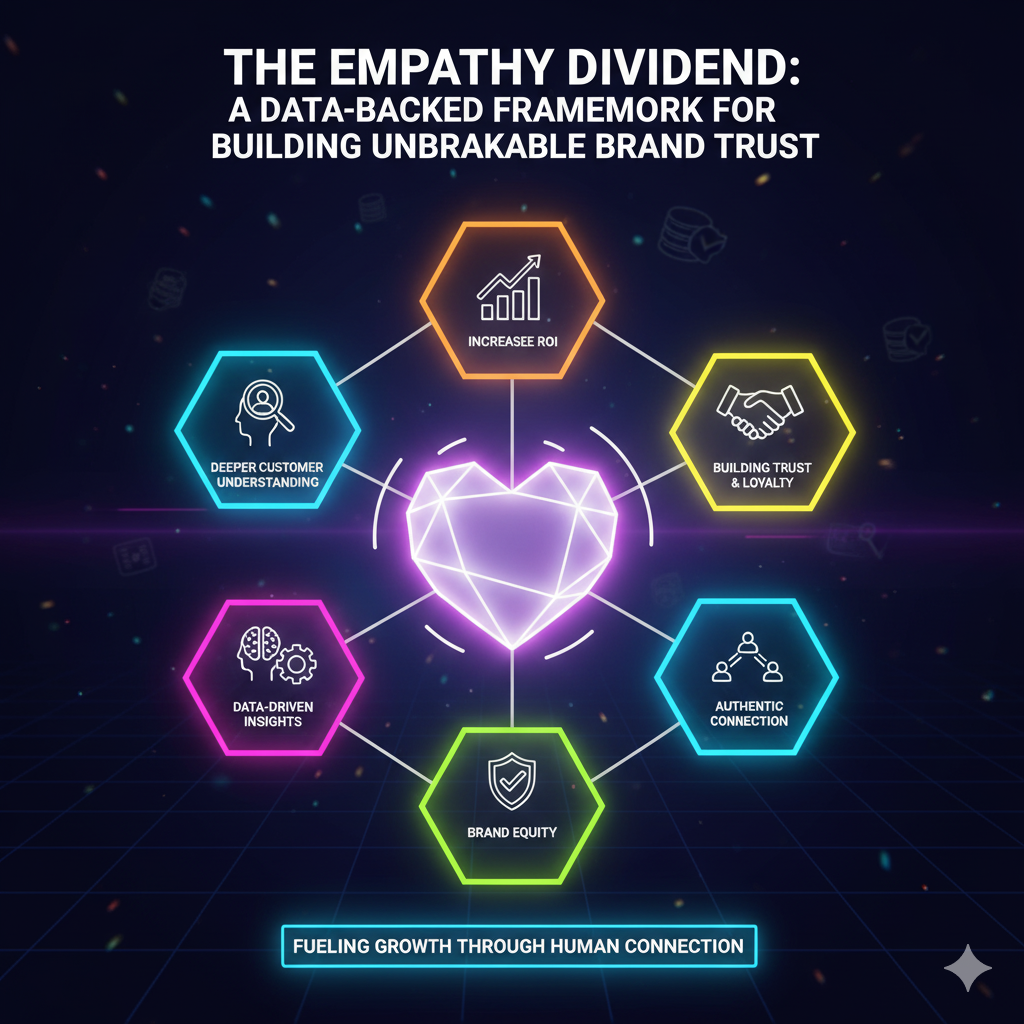
In an era of declining consumer trust, a new marketing paradigm is emerging—where the ability to genuinely understand your customer is a competitive advantage.
As Rust (2020) declares, the future of marketing belongs to those who can bridge the emotional gap. This isn’t a soft skill; it’s a strategic, profit-driving discipline. Research by Lee (2016) quantifies this, revealing that empathetic brands achieve a 28% higher customer equity, proving that empathy isn’t just good ethics—it’s good economics.
The Psychological Foundation: Why Empathy Works
At its core, empathy in marketing is about mirroring the human brain’s decision-making process. Rolls (2014) explains that 95% of purchasing decisions are driven by emotional brain systems, not rational calculus. To tap into this, we must understand the different dimensions of empathy itself. Batson (2009) identifies eight distinct types, but for marketers, two are paramount: Cognitive Empathy (the ability to understand a customer’s perspective) and Empathic Concern (the drive to care about their well-being).
This understanding allows us to target what Ingwer (2012) calls the “Hidden Emotional Needs” behind every decision—needs for Security, Significance, Connection, and Freedom. When Dove’s “Real Beauty Sketches” campaign revealed a profound gap in how women see themselves versus how others see them, it wasn’t just selling soap; it was addressing a deep, universal need for Significance and authentic self-perception, creating a seismic cultural and marketing moment.
From Theory to Practice: Deconstructing Empathetic Campaigns
The most successful campaigns operationalize this psychological insight. Let’s analyze two iconic examples:
- IKEA Homes: Practical Empathy in Action. IKEA doesn’t just sell furniture; it solves living problems. This aligns with Kohler’s (1929) Gestalt Psychology—the idea that we perceive whole patterns, not isolated parts. IKEA understands the “whole” of the customer’s domestic life—the clutter, the small spaces, the need for family harmony. Their content provides holistic solutions that address the emotional need for Security and Autonomy (Ingwer), building trust through practical, relatable empathy.
- Gurmenitsa & Olympus Foods: Cultural & Generational Empathy. These brands excel by embedding themselves in a specific cultural context. Gurmenitsa’s “Super Rustic Manifesto” isn’t a product list; it’s a declaration of values that resonates with a community passionate about tradition and authenticity. Similarly, Olympus Foods’ “Milk for the New Generation” reframes a traditional product for a modern audience. This deep, cultural empathy builds tribal belonging, a powerful driver of loyalty identified by Kim & Sullivan (2019).
Getting Started with Empathetic Marketing: 9 Foundational Steps
There are several ways to get started with the content ideation process with regard to empathetic marketing. Consider the following steps.
1. Develop Buyer Personas
There is no way a brand can create an empathetic, understanding message without fully knowing who their target audience is. This requires a deep understanding of your audience’s age, education, income, interests and lifestyle. Developing buyer personas will help you understand your consumer audience better. When brainstorming, ask yourself:
- Why do they care about your business?
- What motivates them and drives them to make a purchase?
- What do they need?
- What solutions are you providing for their problems?
- What are they currently reading? What are they interested in?
Let the answers to these questions give you guidance on how to determine your buyer persona.
2. Don’t Promote a Message Unless You Have an Authentic Solution
The last thing anyone wants is an underhanded sales pitch when they are looking for a solution to a problem. So, make sure you have an authentic solution for your customers before they even come to you for assistance. Empathy is not the same as sympathy. Empathy is acting with compassion and genuine concern. Marketers should focus on delivering value to consumers, whether that be through an authentic marketing strategy or educational pieces. Companies should recognize when they are not an expert in a field and seek to instead highlight experts when possible.
3. Leverage Informational Content
The goal of editorial content should be to inform and engage prospects and customers, rather than to sell or promote a product. Delivering valuable information to consumers is an effective strategy for building trust. There are several strategies that marketers can employ to educate consumers or address customer pain points. For example, many marketers curate content from thought leaders or invite customers to speak on a webinar focused on a non-promotional topic.
4. Create an Empathy Map
An empathy map can help you understand how your audience thinks and feels. It can also help your content brainstorm be as successful as possible. To make one, divide a sheet of paper into four separate quadrants. Title the sections “Think and Feel,” “Hear,” “See” and “Say and Do.” On another sheet of paper, list your consumer’s pain points and what they’re looking to gain.
Fill in your map based on what you know about your audience. If you don’t know where to start, create a survey for them to take. Most consumers are willing to share this kind of information with businesses. You just have to ask for it!
5. Start Listening and Observing
Humans are wired to listen with the intent to reply rather than the intent to understand. To listen with understanding, you need to actively try to rewire your brain. Start by intently listening to consumers and try to understand the motivations behind their opinions. Above all, you need to listen to what emotions are motivating your clients and why they are acting the way they do. Doing so will help you create compelling marketing messages that get to the heart of whatever issue is plaguing your consumer.
6. Seek to Solve Problems
While it is important to educate and spark the interest of your audience, it is just as important to find and provide solutions to their problems. After all, you are a business that needs sales to survive. However, you need to do so in a way that resonates and solves the biggest problems your consumers are facing.
Empathetic companies understand their customer’s everyday problems and strive to solve them by creating a product or a service. When it comes to promoting these solutions, it all boils down to content production. Your content should aim to point out the problems your audience faces in an empathetic manner while providing them with solutions that feel genuine and generate conversion. For example, if you are a financial platform, you can consider supplementing your finech or banking content strategy with financial news or a business news service to help consumers make better decisions. Consider how your digital content marketing strategy can help customers better solve the problems they face. The content that marketers deliver should be of value to their audiences.
7. Tell Stories to Drive Conversations
Since almost everything we do happens behind a screen, it is common for many consumers to feel as if they are being talked at instead of talked to. Stories resonate more than simple marketing ploys, and you should create your marketing plan based on a story you want to tell. Your story needs to get into the hearts and minds of all consumers.
Focus on driving full conversations instead of one-off chats with consumers. The more you can keep customers coming back for more, the better. Try your hardest not to push your agenda. Instead, extend an invitation to converse and share ideas. You need to demonstrate that you are interested in your consumer’s world, not just their one-time purchase.
8. Speak Clearly
We have all seen marketing campaigns that have left us wondering, “What did I just read?” It is all too easy for marketers to get in over their heads when it comes to messaging. And it is a common misconception that marketing campaigns must be filled with elevated and hard-to-understand language in order resonate with consumers. What consumers actually want is clear, concise copy. Write how you would talk to your consumers and keep it simple! Additionally, include graphics, photos or other visuals to help illustrate your points. Images can help make articles more clear to consumers.
9. Be Human
At the end of the day, you’re human. There’s a person behind every business, and you have the same wants and needs as everyone else. Empathy is a part of human nature and something we have all experienced, whether it has been in our personal or professional lives. With this in mind, find a way to relate to your customer base and provide them with content that’s relevant to their lives. Marketers who deliver authenticity in their campaigns are better able to deliver value to consumers. Connection is everything, and a simple act of community can mean all the difference between a potential customer and a consumer that keeps coming back for more.
The Markempai EMPATHY Framework: A Strategic Blueprint
Moving beyond foundational steps, we’ve developed a proprietary framework based on the synthesized research to help you build a systematically empathetic organization.
E – Evaluate Emotional Needs
Use Davis’s (1983) Interpersonal Reactivity Index (IRI) as a model to assess your team’s empathetic capacity. Simultaneously, map your customer data against Ingwer’s 8 Hidden Emotional Needs to identify the core drivers behind their behavior. Our Customer Insight & Persona Development service can operationalize this for you.
M – Map the Holistic Emotional Journey
Don’t just map touchpoints; map feelings. Use Kohler’s Gestalt principle to understand the customer’s entire emotional experience with your brand, from initial anxiety to post-purchase satisfaction. This reveals the “empathy gaps” where customers feel misunderstood or unsupported.
P – Personalize with Hybrid Intelligence
Bridge the gap between scale and soulfulness. As Gorry & Westbrook (2011) noted, technology can hinder empathy if not designed for it. Leverage Liu-Thompkins et al. (2022) research on Artificial Empathy by using AI to analyze sentiment and personalize at scale, but ensure a seamless handoff to human teams for complex, compassionate interactions.
A – Act with Authentic Solutions
Every piece of content must pass the “Dove Test”: Does it provide a genuine solution or merely a sales pitch? As Andreasen & Kotler (2003) demonstrate in the nonprofit sector, mission-driven action builds deeper trust than transactional outreach.
T – Train for Empathetic Competency
Empathy is a muscle that must be strengthened. Based on Kostadinova & Antonova’s (2018) work on competency in healthcare, develop formal training for your teams in active listening, perspective-taking, and compassionate communication.
H – Harness Pro-Social Storytelling
Facts tell, but stories sell—on a neurological level. Use the principles of Kim & Sullivan (2019) to craft narratives that foster connection and tribal identity. Feature real customer stories (like Rostar’s creative executions) and use clear, human language to drive conversations, not monologues.
Y – Yield & Measure the Empathy Dividend
Finally, close the loop. Track the metrics that matter: Customer Lifetime Value (as per Lee, 2016), brand loyalty, and reduced price sensitivity. Use Pedersen’s (2021) empathy-based marketing scales to qualitatively assess your progress.
| Empathy Dimension | Key Researcher | Metric to Track |
|---|---|---|
| Cognitive (Understanding) | Batson (2009), Davis (1983) | Customer Satisfaction (CSAT) on support interactions |
| Emotional (Feeling) | Rolls (2014), Ingwer (2012) | Emotional Sentiment Score in feedback & reviews |
| Compassionate (Acting) | Prasetyoh (2023), Route Case Studies | Customer Effort Score (CES) & Net Promoter Score (NPS) |
The Future is Empathetic
The landscape is clear. The brands that will thrive are those that, as Rust (2020) predicts, make empathy their core differentiator. This requires moving beyond performative campaigns and building a robust Empathy Infrastructure—one that combines deep human understanding with smart technology, all focused on delivering genuine value.
The empathy dividend is waiting to be claimed. It’s time to stop talking at your customers and start building with them.
Additional Sources & References
- https://marketingsherpa.com/article/case-study/empathy-marketing
- https://www.digitalsilk.com/digital-trends/customer-loyalty-statistics/
- https://www.ainoa.agency/blog/empathetic-marketing-guide-brand-empathy
- https://level343.com/search-marketing-articles/the-power-of-empathy-in-marketing/
- https://onlinelibrary.wiley.com/doi/full/10.1002/mar.22130
- https://www.researchandmetric.com/blog/consumer-psychology-buying-decisions-emotional-factors/
Related Markempai Resources
- Empathy-Based Marketing: Empathy-Based Marketing – markempai.com
- Empathy Maps: A Complete Guide: Empathy Maps: A Complete Guide – markempai.com
- Why Empathy in Marketing Is Important: Why Empathy in Marketing Is Important – markempai.com
- Why Empathy in Marketing Matters More Than Ever: An Evidence-Based Guide: Why Empathy in Marketing Matters More Than Ever: An Evidence-Based Guide – markempai.com
- The Importance of Empathy in Marketing: The Importance of Empathy in Marketing: A Three-Part Series – markempai.com
- Developing an Empathetic Marketing Strategy: A Framework for Authentic Connection: Developing an Empathetic Marketing Strategy: A Framework for Authentic Connection – markempai.com
- What Is Empathy in Marketing and Why It Matters: The Definitive Guide: What Is Empathy in Marketing and Why It Matters: The Definitive Guide – markempai.com
- Empathy in Marketing: The Definitive Guide to Connecting With Customers & Driving Unshakeable Brand Loyalty:Empathy in Marketing: The Definitive Guide to Connecting With Customers & Driving Unshakeable Brand Loyalty – markempai.com
- Empathetic Marketing: The Power of Empathy in Advertising That Builds Unbreakable Brand Loyalty: Empathetic Marketing: The Power of Empathy in Advertising That Builds Unbreakable Brand Loyalty – markempai.com
- The Role of Empathy in Modern Marketing: How Emotional Intelligence Drives Sustainable Business Success: The Role of Empathy in Modern Marketing: How Emotional Intelligence Drives Sustainable Business Success – markempai.com
- Empathetic Marketing: The Ultimate Guide to Building Authentic Customer Connections in 2025: Empathetic Marketing: The Ultimate Guide to Building Authentic Customer Connections in 2025 – markempai.com
Ready to Transform Your Marketing Through Empathy?
If you’re ready to harness the proven power of empathetic marketing, the team at Markempai is here to help. With our unique blend of psychological insight, strategic rigor, and creative excellence, we deliver measurable results that strengthen both your brand and your bottom line.
markempai.com |info@markempai.com