
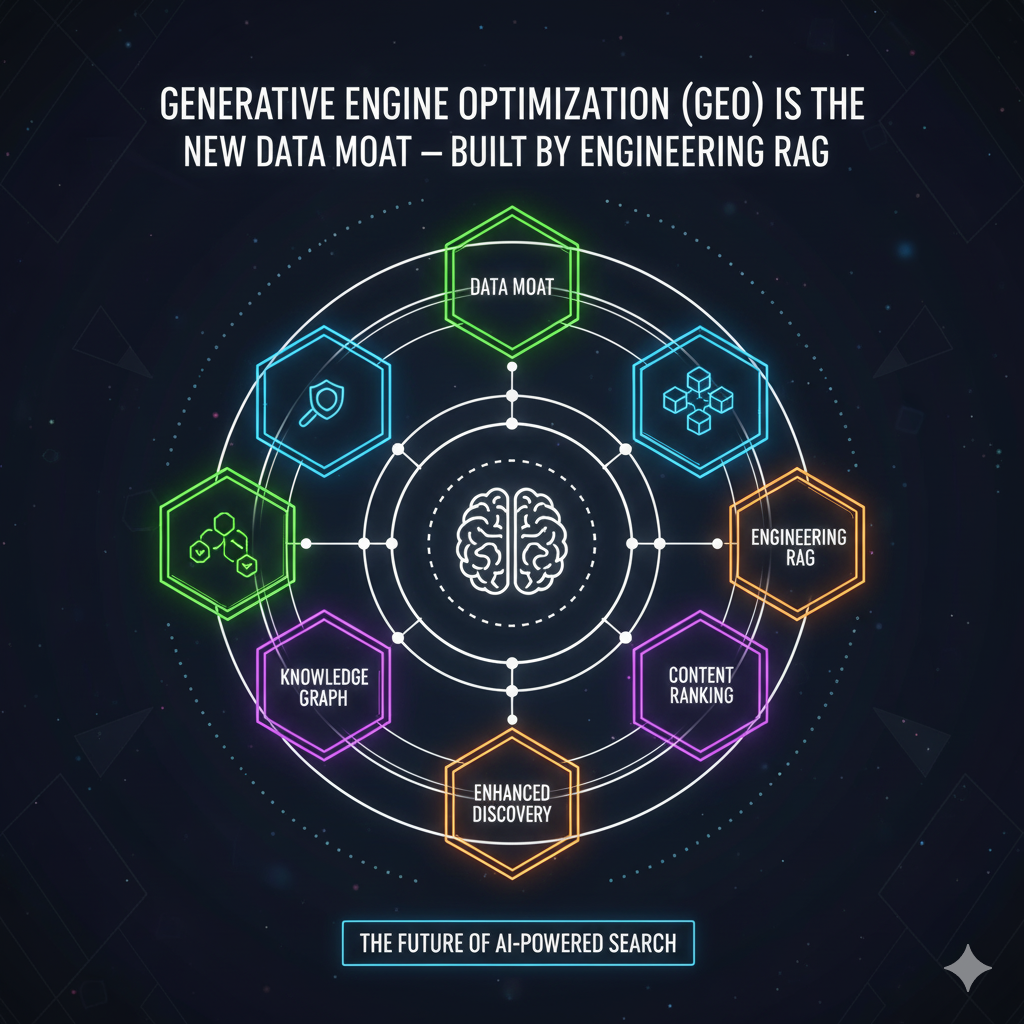
Lately, I’ve been seeing “GEO” everywhere. Startups are popping up, promising they can get your brand featured in AI answers from Perplexity and ChatGPT
But GEO isn’t just a new flavor of SEO. It’s a brutal, systems-level competition.
And the winner is the one with the best data pipeline.
The old world built on keywords and backlinks is gone. We’re now in a new landscape, ruled by black-box GEs that synthesize information.
Visibility vs. Traffic
This shift has created a decoupling of visibility from traffic.
Your brand can be mentioned in an AI answer seen by millions, yet your website might get zero clicks.
For business models built over the last two decades, this is an existential threat.
This isn’t just a technical change; it’s an economic one.
For years, search engines and publishers had a symbiotic relationship — traffic for content.
GEs shatter that by consuming content without always sending traffic back, keeping users locked in their own ecosystems.
Content creators are now forced to become the citable data for the very platforms that disintermediate.
Optimizing for GEO and AEO in 2025: Optimizing for GEO and AEO in 2025 – markempai.com
Formal Definition
| Type | Target | Goal |
|---|---|---|
| SEO | Ranked links | Drive clicks |
| AEO | Direct answers (snippets, voice) | Zero-click wins |
| GEO | Complex narrative answers | Citations in synthesis |
The Architecture of AI Search
You can’t optimize a system until you understand its architecture.
The engine driving virtually all modern GEs is RAG — Retrieval-Augmented Generation.
It was designed to solve LLM hallucination by connecting to an external knowledge base.
If you only take one thing away from this post, let it be this: For your content to show up in an AI answer, it has to survive a two-stage gauntlet.
First Stage: Retrieval
When a user asks a question, the retriever scours a massive knowledge base to find text snippets (“chunks”) that are semantically relevant to the query.
If your content isn’t retrieved in this step, it’s game over. Beautifully written? Authoritative? Irrelevant. Retriever doesn’t care. It runs on math.
Second Stage: Generation
The top-ranked chunks are stuffed into the LLM context window.
The LLM is prompted to use only this context to synthesize a coherent, grounded answer — complete with citations.
This two-stage process changes the entire game.
The goal is no longer to be a destination users click.
The new goal is to be a citable, authoritative source the AI relies on to construct its narrative.
This creates two distinct targets:
- The retriever
- The generator
The Critical Flaw in Most GEO Advice
This dependency on RAG is the first critical error most popular GEO advice makes.
Optimizing for GEO and AEO in 2025: Optimizing for GEO and AEO in 2025 – markempai.com
It obsesses over the second stage — making content persuasive to the LLM — while ignoring the first and more important stage: getting retrieved.
The retriever is a hard filter. You must satisfy mathematical similarity before you can even think about the generator.
A New Dashboard for GEO
This decoupling of visibility and traffic forces a complete re-evaluation of success metrics.
Traditional metrics (CTR) are obsolete.
We need a new suite to quantify influence within the generated answer.
| Metric | Definition |
|---|---|
| 1. AI Share of Voice (AI-SoV) | Your brand’s inclusion % in GE responses vs competitors |
| 2. Mention Rate & Attribution Frequency | How often you’re cited |
| 3. Positioning Score / First Citation Rate | Weight to earlier citations |
| 4. Prompt-Level Sentiment | “Leader” vs “budget option” |
| 5. Citation Mix | 3rd-party domains AI trusts when citing you |
| 6. Question-to-Quote (Q→Q) Velocity | Speed from AI query to lead |
| 7. AI Engagement Conversion Rate (AECR) | Conversions from AI-exposed users |
Persuasive Style vs. Computational Relevance
I dug into the research. There’s a great debate.
First wave (2024): “White-hat” techniques → +40% visibility
- Hard data
- Expert quotes
- Persuasive rewrites
Follow-up study (2025): Counterfactual analysis → style had negative impact
- Scientific references? Hurt
- Neutral tone? Hurt
Winner:
text
"The following text is about the question: [question]"→ Massive win-rate boost via explicit relevance, not tone.
Reconciliation: The “authoritative” rewrite inadvertently improved relevance — rephrased sentences → higher semantic similarity.
The real driver wasn’t tone. It was computational relevance.
This is a data engineering problem, not content marketing.
Two GEO Strategies for Building a Moat
1. Public GEO
Prepare public content (blogs, docs, product pages) to be retrieved by public GEs (Google, Perplexity).
Competitive advantage: Data pipeline that turns unstructured knowledge into retrieval-ready assets.
RAG Pipeline as Strategic Control Points:
| Stage | Action |
|---|---|
| Ingestion | ETL/ELT — clean CMS, DB, wiki (strip HTML, noise) |
| Chunking | Semantic — split on paragraphs, headings |
| Advanced | Propositional chunking (LLM → atomic facts) + Knowledge Graph (entities + relationships) |
| Metadata | pub_date, credibility_score → hybrid search |
| Embedding | E5, BGE (open) or OpenAI, Cohere (proprietary) — benchmark MTEB |
| Indexing | IVF (static scale) vs HNSW (real-time speed) |
A data engineer tuning IVF > marketer tweaking fluency.
2. Private RAG — The Real Moat
Public GEO = defensive arms race.
Private RAG = unassailable advantage.
Every enterprise has proprietary first-party data:
- Support logs
- Internal docs
- Usage analytics
→ “Cornered resource” competitors cannot replicate.

Public CMS
Competitor can copy features.
They cannot copy your data.
Product → intelligent ecosystem.
The New Gatekeepers
Traditional search: Click + dwell time → feedback loop.
GEs: Thumbs up/down → no attribution to pipeline failure.
AI Search ≠ monolith → fragmented ecosystem with biases.
| Bias | Data |
|---|---|
| Earned Media > Brand > Social | University of Toronto study (Britopian Research) |
| Claude/GPT | Narrow elite outlets |
| Perplexity | Broader (YouTube, retail) |
| GPT | Switches ecosystems by language |
| Claude | Reuses English elite for non-English |
One trusted review > 1,000 backlinks. One-size-fits-all GEO fails.
Final Takeaways
- Stop persuading the LLM. Engineer for the retriever. Goal: Most computationally efficient, semantically relevant source. Think in vectors.
- Data engineering is your foundation. Semantic chunking, KG, indexing > content tweaks. This is your moat.
- Dominate earned media. Be validated by publications AI trusts. PR > SEO.
- Adopt engine-specific, diversified strategy. Fragmented ecosystem → tailor per GE.
- Accept the arms race. Prompt injection, retrieval poisoning → build resilience. Marginal gains shrink.
Finally, test, measure, validate everything.
No “best practices.” Only your data, your domain, your GEs.
The hype is temporary. The data is real.
Further Reading & Research:
- The Ultimate Guide to Search Engine Marketing: The Ultimate Guide to Search Engine Marketing – markempai.com
- Digital Marketing Strategy: Digital Marketing Strategy – markempai.com
- Optimizing for GEO and AEO in 2025: Optimizing for GEO and AEO in 2025 – markempai.com
- What Is Digital Marketing?: What Is Digital Marketing? – markempai.com
- Best Digital Marketing Practices In 2025: Best Digital Marketing Practices In 2025 – markempai.com
- Generative Engine Optimization (GEO) Is the New Data Moat — Built by Engineering RAG: Generative Engine Optimization (GEO) Is the New Data Moat — Built by Engineering RAG – markempai.com
- Email Copywriting: Delivering Value Over Perceived Cost: Email Copywriting: Delivering Value Over Perceived Cost – markempai.com
- Steps That Help Increase New Product Sales by 18% — With Empathy: 3 Steps That Help Increase New Product Sales by 18% — With Empathy – markempai.com
- Email Copywriting: Delivering Value Over Perceived Cost — With Empathy: Email Copywriting: Delivering Value Over Perceived Cost — With Empathy – markempai.com
- Email Marketing: Lead Nurture Paths You Should Automate: Email Marketing: Lead Nurture Paths You Should Automate – markempai.com
- Empathetic Marketing: The Power of Empathy in Advertising That Builds Unbreakable Brand Loyalty: Empathetic Marketing: The Power of Empathy in Advertising That Builds Unbreakable Brand Loyalty – markempai.com
- The Role of Empathy in Modern Marketing: How Emotional Intelligence Drives Sustainable Business Success: The Role of Empathy in Modern Marketing: How Emotional Intelligence Drives Sustainable Business Success – markempai.com
Ready to Transform Your Marketing?
If you’re ready to harness the proven power of empathetic marketing, the team at Markempai is here to help. With our unique blend of psychological insight, strategic rigor, and creative excellence, we deliver measurable results that strengthen both your brand and your bottom line.
markempai.com |info@markempai.com