
Introduction: The Misunderstood Role
In today’s digital landscape, having a robust social media presence is non-negotiable. This often leads business owners to make a dangerous assumption: that the person managing their social media feeds is, by definition, their Digital Marketing Expert.
This confusion is not harmless. It results in disjointed campaigns, misallocated budgets, and, critically, a failure to generate predictable, sustainable revenue. It is like asking a skilled violinist to conduct a full symphony orchestra—they are masters of their instrument, but they lack the holistic view and strategic command of the entire ensemble.
Part 1: Digital Marketing: The Architect and the Battlefield
To understand the specialization, we must first define the whole. Digital Marketing is the umbrella discipline encompassing all marketing efforts that use an electronic device or the internet.
The Digital Marketing Expert: The Conductor and Strategist
The Digital Marketing Expert (or Manager/Specialist) is the architect of the entire online growth strategy. They are focused on the ultimate business goal: driving measurable leads, conversions, and sales using every digital channel available.
Core Scope: Holistic Channel Management
A Digital Marketing Expert’s responsibilities extend across the entire customer journey and multiple channels:
- Search Engine Optimization (SEO): Ensuring the website ranks highly on Google to capture organic, high-intent traffic.
- Pay-Per-Click (PPC) Advertising: Managing paid campaigns across Google Ads, Bing, and sometimes LinkedIn, focusing on cost-per-acquisition (CPA) and Return on Ad Spend (ROAS).
- Content Strategy: Planning the overall editorial calendar—blogs, whitepapers, case studies—that drives traffic and nurtures leads.
- Email Marketing: Designing automation workflows, segmentation strategies, and nurturing campaigns to move leads through the sales funnel.
- Website & Conversion Rate Optimization (CRO): Ensuring the brand’s primary digital asset (the website) is user-friendly, loads quickly, and is optimized to convert traffic into actions.
- Analytics & Attribution: The most crucial element—they use tools like Google Analytics to track every single customer touchpoint, understanding which channels are actually driving revenue, not just vanity metrics.
Primary Goal: Generating Qualified Leads and Measuring ROI.
Their key focus is on the middle and bottom of the funnel—getting a user to take a meaningful action that contributes to the sales pipeline. They are ROI-obsessed and think in terms of conversions and profitability.
Part 2: Social Media Management: The Specialist and The Community
The Social Media Manager: The Engagement Master and Brand Voice
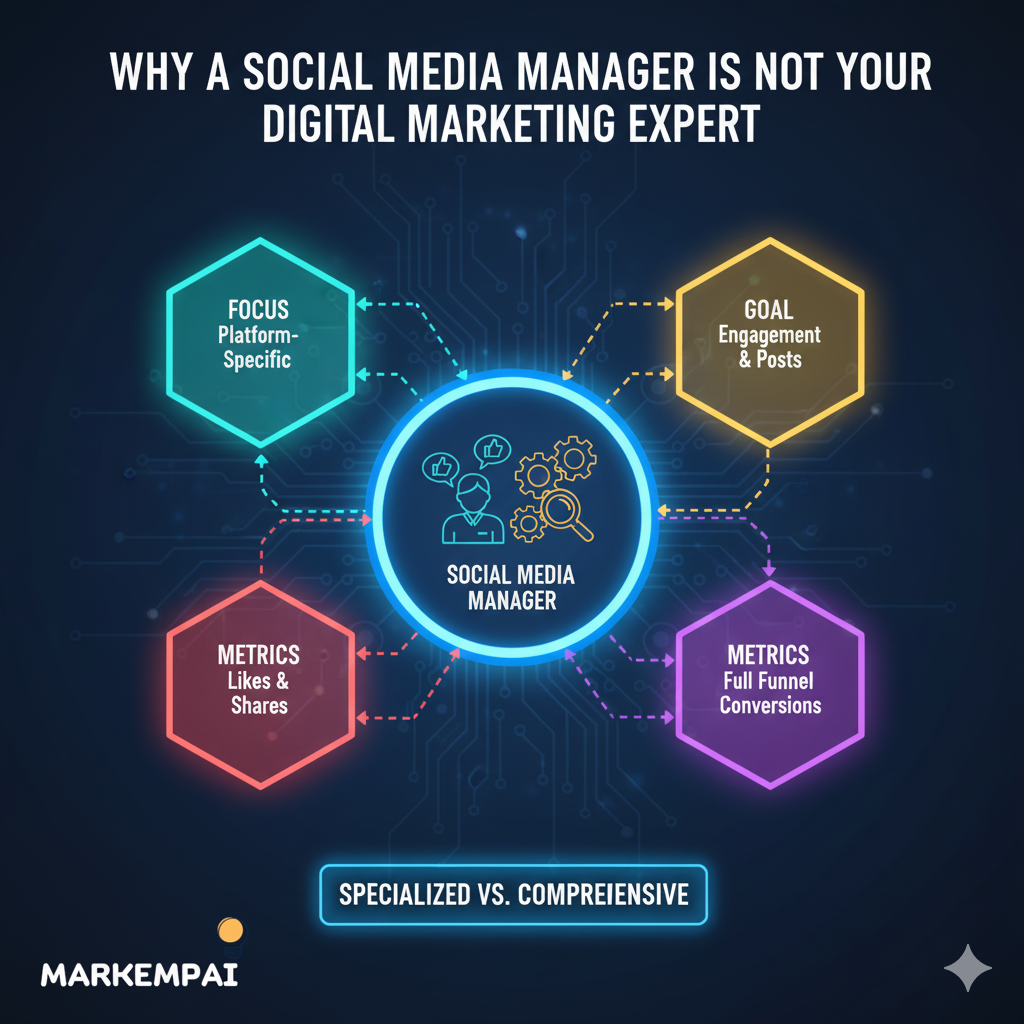
The Social Media Manager (SMM) is a specialized practitioner whose entire focus is a subset of the Digital Marketing Expert’s world: the social media platforms themselves (Facebook, Instagram, LinkedIn, TikTok, X/Twitter, etc.).
Core Scope: Deep Platform Mastery
The SMM’s world is focused on two primary activities: Content Creation and Community Management.
- Content Calendar & Posting: Creating, scheduling, and publishing platform-specific content (visuals, videos, captions) on a consistent basis.
- Community Engagement: The heavy lifting of real-time interaction—responding to comments, messages, direct inquiries, and fostering a positive, active community.
- Trend and Platform Niche: Deep knowledge of platform algorithms, best practices, and the latest viral trends to maximize organic reach and maintain relevance.
- Organic Reach & Brand Awareness: Their primary metric is often reach, engagement rate, impressions, and follower growth—metrics focused on the top of the funnel (awareness).
Primary Goal: Building Brand Awareness and Fostering an Engaged Community.
The SMM excels at making the brand human, approachable, and relevant. They build the relationships that the Digital Marketing Expert later leverages for conversion.
Part 3: The Critical Differences in Action
The differences in scope translate to radically different skill sets and day-to-day work:
| Aspect | Digital Marketing Expert | Social Media Manager (SMM) |
| Scope | Holistic, multi-channel strategy (SEO, PPC, Email, Web, Social). | Niche focus on social media platforms (organic and some paid social). |
| Primary Goal | Measurable ROI, Lead Generation, Sales Conversion. | Brand Awareness, Engagement Rate, Community Growth, Customer Service. |
| Key Metrics | Conversion Rate, CPA, ROAS, Lifetime Value (LTV), SEO Ranking. | Impressions, Follower Count, Engagement Rate, Comments, Shares. |
| Key Skills | Data Analytics, Technical SEO, Strategic Planning, Budget Management, CRO, HTML/CMS knowledge. | Copywriting, Graphic Design/Video Editing, Real-Time Community Management, Platform Algorithm Mastery, Crisis Comms. |
| The Analogy | The General who plans the entire war. | The Scout who provides intel and manages the frontline communication. |
The Danger of Hiring Just an SMM
When a business expects an SMM to be a Digital Marketing Expert, the following gaps in your strategy emerge:
- No Lead Flow Beyond Social: You get beautiful, engaging social feeds, but no optimized website, no traffic from Google, and no email nurturing sequence to convert leads who are ready to buy.
- Focus on Vanity Metrics: You celebrate high “likes” and “shares” without knowing if those actions contribute to the bottom line, confusing activity with achievement.
- Strategic Disconnect: The social media content may not align with the PPC campaigns, the SEO keywords, or the overall business objectives, leading to a disjointed and confusing customer experience.
- No Accountability for Revenue: If sales are flat, the SMM can rightly point to high engagement, while the true failure lies in the lack of a cohesive, measurable digital marketing strategy that connects engagement to revenue.
The Markempai Perspective: Integrated Strategy
The most successful businesses, especially in the B2B space Markempai serves, recognize that these two roles must collaborate under one unified strategy.
The Digital Marketing Expert sets the strategic direction—”Our goal this quarter is to generate 50 qualified leads for our Empathy Engineered™ service.”
The Social Media Manager then executes the specific social component—”We will use LinkedIn thought leadership to drive traffic to the blog posts that the Digital Marketing Expert has optimized for SEO, and we will engage with every comment to build confidence and trust.”
Collaboration is key. Substitution is failure.
Conclusion: Stop Confusing the Part for the Whole
Digital marketing is a sophisticated, multi-faceted discipline where every channel—Search, Email, Web, and Social—plays a unique, yet interconnected, role.
If you are looking for engagement and community, hire a Social Media Manager. If you are looking for Systematic Growth, Measurable ROI, and the strategic direction that connects every digital effort to your business revenue, you need a Digital Marketing Expert to architect the whole plan.
Don’t let the costly confusion between these two roles stall your growth.
Is your current digital strategy suffering from a lack of strategic oversight? Markempai specializes in architecting holistic, Empathy Engineered™ digital strategies that turn likes into leads and build lasting trust. Let’s audit your current channels.
The Future of Digital Growth: Why Strategy Separates the Expert from the Specialist in 2025
Introduction: The Digital Jargon Trap
The digital world is a place of rapid evolution, but one confusion persists: the interchangeable use of “Digital Marketer” and “Social Media Manager.” This misunderstanding is more than semantic; it’s a strategic blind spot that costs businesses growth opportunities and misallocates budgets.
In 2025, with Artificial Intelligence (AI) augmenting every task and consumers demanding hyper-personalized, omnichannel experiences, the roles have become more specialized and the required skill sets more distinct than ever.
Part 1: The Evolving Roles in the 2025 Digital Ecosystem
The core distinction remains: Digital Marketing is the holistic ecosystem; Social Media Marketing is a powerful component within it.
The Digital Marketing Expert in 2025: The AI-Augmented Strategist
The Digital Marketing Expert is the Chief Growth Officer of the online world. Their job is not just to execute tasks, but to design a coherent, full-funnel strategy that spans multiple channels and prioritizes measurable revenue.
🎯 Focus Areas (2025) 🛠️ Key Skills and Tools Hyper-Personalization at Scale AI Literacy & Prompt Engineering: Using Generative AI to create tailored content variants (emails, ads, landing pages) that adapt in real-time to user behavior. Privacy-First Data Strategy GA4 Mastery & First-Party Data: Moving away from third-party cookies. Building robust data collection systems that are compliant (GDPR, CCPA) to fuel personalization. Omnichannel Experience Design CRM Automation & Lifecycle Marketing: Designing seamless customer journeys that flow logically from social awareness to website conversion to email nurturing. Performance Marketing Advanced Budget Allocation & A/B Testing: Strategically managing PPC (Google/Bing) and Paid Social, focusing on CPA, LTV, and Attribution Modeling, not just traffic. The Digital Marketer’s core challenge is strategic oversight and turning data into a profit-driven narrative. They must be proficient in technical aspects (like SEO and CRO) and possess the analytical skills to know which channel is delivering the most valuable customer.
The Social Media Manager in 2025: The Real-Time Humanizer
The Social Media Manager (SMM) is the brand’s voice and community concierge. While still responsible for content, their role in 2025 has shifted heavily towards real-time engagement, crisis management, and short-form video optimization.
📣 Focus Areas (2025) 🎨 Key Skills and Tools Short-Form Video Mastery Content Creation & Editing: Expertise in creating attention-grabbing, ephemeral content (TikTok, Reels, Shorts) that drives organic reach and discovery. Social Commerce & Shoppable Content Platform-Native E-commerce Features: Utilizing in-app shopping features, live-streaming sales, and direct messaging for sales conversion. Community Nurturing & Engagement Empathy-Driven Communication: Building two-way dialogue, responding to comments and DMs, and fostering user-generated content (UGC) to build authentic trust. Platform Search Optimization Social SEO: Optimizing content with keywords and hashtags for platforms (like TikTok and YouTube) that are increasingly functioning as search engines for younger audiences. The Social Media Manager’s core challenge is mastering the cultural, aesthetic, and algorithmic nuances of individual platforms to build emotional connection and immediate engagement. They are the masters of the Top-of-Funnel (ToFu) awareness.
Part 2: The Three Major Gaps Created by the Confusion
When a business mistakes an SMM for a DM Expert, the unified strategy required to succeed in 2025 completely collapses, resulting in three critical failures:
1. The Attribution Gap
The SMM reports on engagement (likes, shares, comments), which feel good but are often vanity metrics. The DM Expert needs to know the Attribution—Did that like on LinkedIn actually lead to a demo request or a contract signature? Without a DM Expert overseeing the tracking and analytics (especially with the complexity of GA4), the business celebrates activity but remains blind to profitability.
2. The User Journey Gap (Omnichannel Failure)
In 2025, consumers expect a seamless journey. If the SMM generates excitement on TikTok, but the user clicks to a slow, unoptimized landing page that doesn’t follow the brand’s tone (the domain of the DM Expert’s CRO and Web strategy), the lead is instantly lost. The confusion creates silos where social media is a dead-end, instead of an integrated on-ramp to conversion.
3. The AI Implementation Gap
AI is not a single button; it’s a strategic layer.
- The DM Expert uses AI for strategic automation: optimizing ad spend, predicting churn, and segmenting large lead lists for hyper-personalization.
- The SMM uses AI for creative augmentation: generating captions, suggesting image variants, and summarizing trends.
If the SMM is forced to choose and manage the complex AI tool stack without the DM Expert’s strategic input, the business misses out on the predictive, revenue-boosting power of AI.
Conclusion: The Path to Systematic Growth
In 2025, both roles are essential, but their functions are rigidly separate. The Social Media Manager builds the emotional connection and manages the conversation. The Digital Marketing Expert builds the pipeline, manages the budget, and provides the strategic framework—using data and technology—to convert that connection into revenue.
For Markempai’s B2B clients, this means recognizing that you need an Empathy Engineered™ Digital Strategy first, to define why you are communicating, before handing the reins to a specialist who masters where and how to communicate.
To ensure your strategy is built on a solid foundation, not just fleeting trends, partner with Markempai to align your channels with a conversion-focused, Empathy Engineered™ strategy.
Frequently Asked Questions (FAQ)
Q1: Can one person be both a Social Media Manager and a Digital Marketing Expert?
A: In very small businesses or startups, one person might wear both hats out of necessity. However, as the company scales, the depth of knowledge required for technical SEO, complex PPC, and high-level social content makes it nearly impossible for one person to be an expert in all areas. Successful scaling requires specialization.
Q2: Does Social Media Marketing include Paid Advertising?
A: Yes, Social Media Marketing includes both organic content (what a typical SMM focuses on) and Paid Social Advertising (often a function shared between the SMM and the Digital Marketing Expert, who manages the budget and overall conversion tracking).
Q3: Which role should a small business hire first?
A: If your biggest problem is zero online presence and you need fast brand recognition, a skilled Social Media Manager to build a community is a good start. However, if your biggest problem is generating sales/leads, you need a Digital Marketing Expert or Strategist first to build the foundational channels (Website, SEO, Email) that will convert the awareness the SMM creates.
Q4: What is the main metric difference between the two roles?
A: The Digital Marketing Expert focuses on Conversions (transactions, sign-ups, form submissions). The Social Media Manager focuses on Engagement (likes, comments, shares, views). The key to success is linking the SMM’s engagement metrics to the DM Expert’s conversion metrics.
Q5: How does Markempai’s Empathy Engineered™ approach apply to these roles?
A: Our methodology is applied at the strategic level by the Digital Marketing Expert. It ensures that the overall channel strategy (which audiences to target, which messages to use) is based on deep customer empathy. The Social Media Manager then executes this empathetic voice through every real-time comment and piece of content.
Navigating the AI-Driven Landscape: The Crucial Divide Between Digital Marketing and Social Media Management
Introduction: The Digital Jargon Trap
The digital world is a place of rapid evolution, but one confusion persists: the interchangeable use of “Digital Marketer” and “Social Media Manager.” This misunderstanding is more than semantic; it’s a strategic blind spot that costs businesses growth opportunities and misallocates budgets.
In 2025, with Artificial Intelligence (AI) augmenting every task and consumers demanding hyper-personalized, omnichannel experiences, the roles have become more specialized and the required skill sets more distinct than ever.
Part 1: The Evolving Roles in the 2025 Digital Ecosystem
The core distinction remains: Digital Marketing is the holistic ecosystem; Social Media Marketing is a powerful component within it.
The Digital Marketing Expert in 2025: The AI-Augmented Strategist
The Digital Marketing Expert is the Chief Growth Officer of the online world. Their job is not just to execute tasks, but to design a coherent, full-funnel strategy that spans multiple channels and prioritizes measurable revenue.
| Focus Areas (2025) | Key Skills and Tools |
| Hyper-Personalization at Scale | AI Literacy & Prompt Engineering: Using Generative AI to create tailored content variants (emails, ads, landing pages) that adapt in real-time to user behavior. |
| Privacy-First Data Strategy | GA4 Mastery & First-Party Data: Moving away from third-party cookies. Building robust data collection systems that are compliant (GDPR, CCPA) to fuel personalization. |
| Omnichannel Experience Design | CRM Automation & Lifecycle Marketing: Designing seamless customer journeys that flow logically from social awareness to website conversion to email nurturing. |
| Performance Marketing | Advanced Budget Allocation & A/B Testing: Strategically managing PPC (Google/Bing) and Paid Social, focusing on CPA, LTV, and Attribution Modeling, not just traffic. |
The Digital Marketer’s core challenge is strategic oversight and turning data into a profit-driven narrative. They must be proficient in technical aspects (like SEO and CRO) and possess the analytical skills to know which channel is delivering the most valuable customer.
The Social Media Manager in 2025: The Real-Time Humanizer
The Social Media Manager (SMM) is the brand’s voice and community concierge. While still responsible for content, their role in 2025 has shifted heavily towards real-time engagement, crisis management, and short-form video optimization.
| Focus Areas (2025) | Key Skills and Tools |
| Short-Form Video Mastery | Content Creation & Editing: Expertise in creating attention-grabbing, ephemeral content (TikTok, Reels, Shorts) that drives organic reach and discovery. |
| Social Commerce & Shoppable Content | Platform-Native E-commerce Features: Utilizing in-app shopping features, live-streaming sales, and direct messaging for sales conversion. |
| Community Nurturing & Engagement | Empathy-Driven Communication: Building two-way dialogue, responding to comments and DMs, and fostering user-generated content (UGC) to build authentic trust. |
| Platform Search Optimization | Social SEO: Optimizing content with keywords and hashtags for platforms (like TikTok and YouTube) that are increasingly functioning as search engines for younger audiences. |
The Social Media Manager’s core challenge is mastering the cultural, aesthetic, and algorithmic nuances of individual platforms to build emotional connection and immediate engagement. They are the masters of the Top-of-Funnel (ToFu) awareness.
Part 2: The Three Major Gaps Created by the Confusion
When a business mistakes an SMM for a DM Expert, the unified strategy required to succeed in 2025 completely collapses, resulting in three critical failures:
1. The Attribution Gap
The SMM reports on engagement (likes, shares, comments), which feel good but are often vanity metrics. The DM Expert needs to know the Attribution—Did that like on LinkedIn actually lead to a demo request or a contract signature? Without a DM Expert overseeing the tracking and analytics (especially with the complexity of GA4), the business celebrates activity but remains blind to profitability.
2. The User Journey Gap (Omnichannel Failure)
In 2025, consumers expect a seamless journey. If the SMM generates excitement on TikTok, but the user clicks to a slow, unoptimized landing page that doesn’t follow the brand’s tone (the domain of the DM Expert’s CRO and Web strategy), the lead is instantly lost. The confusion creates silos where social media is a dead-end, instead of an integrated on-ramp to conversion.
3. The AI Implementation Gap
AI is not a single button; it’s a strategic layer.
- The DM Expert uses AI for strategic automation: optimizing ad spend, predicting churn, and segmenting large lead lists for hyper-personalization.
- The SMM uses AI for creative augmentation: generating captions, suggesting image variants, and summarizing trends.
If the SMM is forced to choose and manage the complex AI tool stack without the DM Expert’s strategic input, the business misses out on the predictive, revenue-boosting power of AI.
Conclusion: The Path to Systematic Growth
In 2025, both roles are essential, but their functions are rigidly separate. The Social Media Manager builds the emotional connection and manages the conversation. The Digital Marketing Expert builds the pipeline, manages the budget, and provides the strategic framework—using data and technology—to convert that connection into revenue.
For Markempai’s B2B clients, this means recognizing that you need an Empathy Engineered™ Digital Strategy first, to define why you are communicating, before handing the reins to a specialist who masters where and how to communicate.
markempai.com |info@markempai.com.
Further Reading & Research:
Best Digital Marketing Practices In 2025: Best Digital Marketing Practices In 2025 – markempai.com
Effective Email Marketing Campaigns: A Guide for Kenyan Businesses: Effective Email Marketing Campaigns: A Guide for Kenyan Businesses – markempai.com
The Ultimate Guide to Search Engine Marketing: The Ultimate Guide to Search Engine Marketing – markempai.com
Digital Marketing Strategy: Digital Marketing Strategy – markempai.com
Optimizing for GEO and AEO in 2025: Optimizing for GEO and AEO in 2025 – markempai.com
What Is Digital Marketing?: What Is Digital Marketing? – markempai.com